


The first time I genuinely understood matchup betting was about four years into tracking my golf results. I had been backing players in outright markets, watching decent selections finish twelfth when I needed a top five, and wondering why my strike rate in SG-driven analysis was not translating to profit. The answer was variance — golf’s outright market distributes outcomes across 150-plus players, and even the highest-probability selection wins only a fraction of the time. Matchup markets cut through that noise. When you believe Player A is in sharper ball-striking form than Player B this week, a head-to-head bet tests exactly that proposition — not whether Player A survives 72 holes of weather, injury, and putting luck.
The Three Matchup Market Types You Need to Understand
UK bookmakers offer matchup betting in three main formats, and they function quite differently. Two-ball matchups — traditional head-to-head betting — pit two players against each other based on their total 72-hole score. Three-ball betting covers a specific round pairing, with settlement based on that single round’s score rather than the full tournament. Tournament matchups are a third variant, often framed as “Player A to finish higher than Player B in the final standings.”
The distinction matters because they require different analytical inputs. Two-ball tournament matchups reward longer-form SG analysis — a player’s ball-striking consistency over recent events, their historical performance at the venue, and their record in high-pressure final rounds. Three-ball bets are shorter-duration, making wave and conditions more significant than overall season form. If morning starters have been scoring three shots better than afternoon groups all week, a three-ball bet on a morning starter has a structural edge that has nothing to do with player quality.
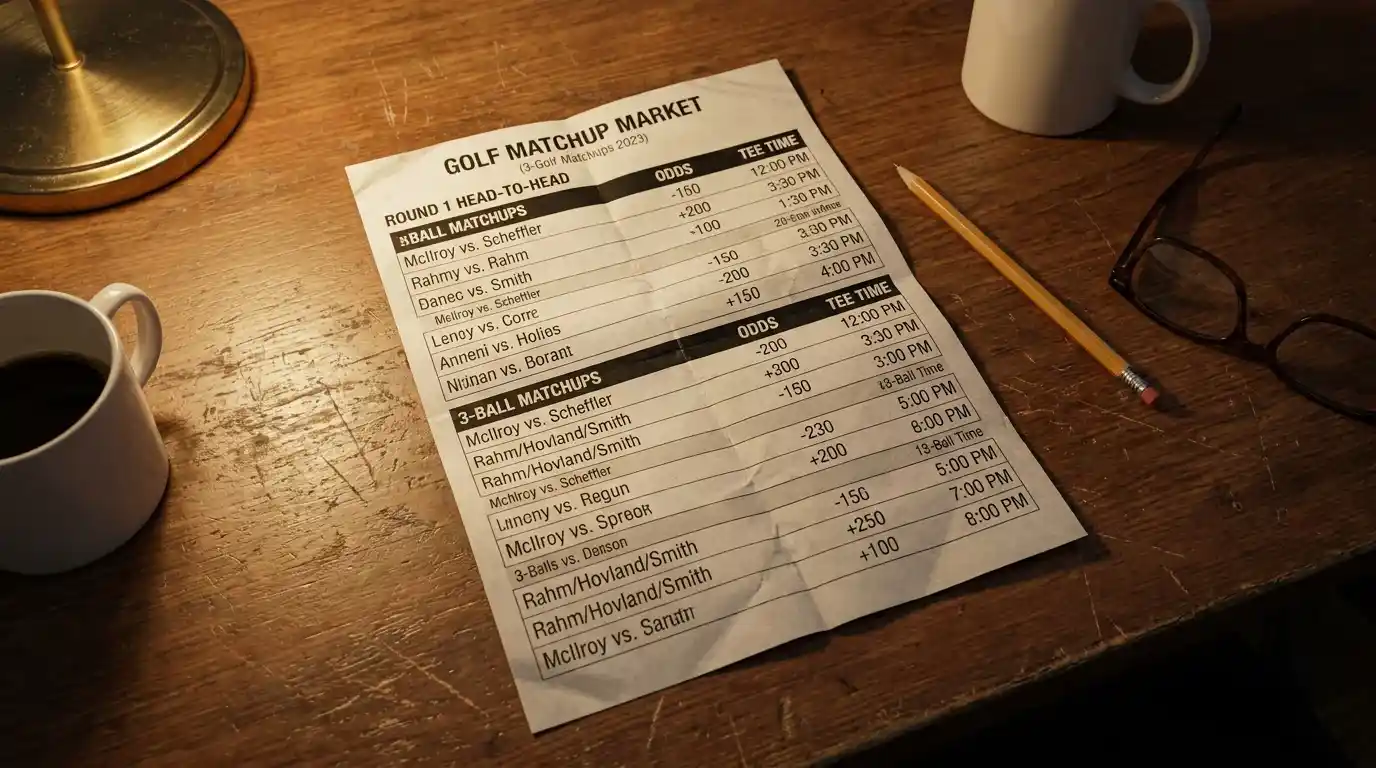
Tournament matchups are where I find the most consistent value because the market is often built around world ranking proximity rather than course-specific data. Two players ranked 20 and 25 in the world look equivalent on paper; if one has finished inside the top four at this venue three times and the other has missed the cut twice, that is a material difference the market frequently underprices.
Using Strokes Gained to Identify Matchup Edges
The analytical bedrock of matchup betting is Strokes Gained data — specifically the split between Tee-to-Green and Putting. Strokes Gained: Tee-to-Green is the more stable and predictive metric week to week. Putting performance fluctuates significantly from event to event, making it less reliable as a matchup discriminator. The data is clear on this: the best performers on approach and off the tee tend to beat their opponents in tournament matchups more consistently than players whose edge is built primarily on the flat stick.
The practical implication is that when I build a matchup case, I look at both players’ SG:T2G over their last 12 to 16 competitive rounds, weighted toward recent events. If Player A has a 1.4 SG:T2G advantage over Player B in that window and the matchup market is offering roughly even money, that is worth serious consideration. The course profile matters too — at venues that emphasise precision approach play over driving distance, a player with strong SG:Approach has a more transferable edge than one whose SG:T2G is driven by distance off the tee.

What I do not do is build matchup cases entirely on raw finishing positions. A player who has three top-10s recently might have been carried there by an unusually hot putting week; their underlying ball striking may be mediocre. Matchups punish that kind of analysis because variance normalises over the smaller sample of a head-to-head comparison.
Draw Timing and the Pairing Advantage
Three-ball markets open with the draw — typically 48 to 72 hours before the first round of a PGA Tour event. The market-opening window is where the best prices sit, before sharp money arrives and before weather forecasts crystallise. I set alerts for draw releases and model the pairings immediately, focusing on two things: wave assignments and relative form.

Wave analysis for three-ball betting is straightforward but requires real-time course setup data. When a tournament site is soft — following overnight rain, or on a links playing downwind in the morning — morning starters consistently score lower than afternoon groups. This shows up year after year in scoring average data split by wave, and yet bookmakers frequently price three-ball markets without fully accounting for it. A player in a morning pairing at a soft, receptive course is not the same betting proposition as a player in the same pairing at a firm, afternoon slot.

The push rule also deserves attention in any three-ball market research. Most UK bookmakers settle three-ball bets as a push if the relevant players tie — which means your stake is returned rather than you winning. Understanding the exact settlement rules for the specific bookmaker matters for sizing three-ball bets correctly.

One additional dimension worth tracking in tournament matchup research is fatigue and scheduling. A player competing in their third consecutive week — particularly on back-to-back trans-Atlantic travel weeks — carries a meaningful performance risk in the back nine of Sunday. Tournament matchups that run to the final round are settled on Sunday performance, and a fatigued player can underperform their season-average SG metrics in a compressed final-round setting. If your matchup analysis shows two players closely matched on SG metrics but one has played two or three consecutive weeks while the other had a rest, that scheduling context should factor into your probability estimate.
Course ownership — specific holes or sections of a course where a player disproportionately performs — is a nuanced but real factor in shorter-format matchup bets. Some players are particularly strong on a course’s outward nine but historically struggle on the back nine, which narrows their lead or advantage in a final-round matchup. This granular data is available from detailed course-by-course SG breakdowns, and while it requires more research, it produces the kind of specific edge that the market does not price into a blunt tournament matchup price.
For more on which UK bookmakers offer the widest coverage of DP World Tour matchup markets, the strokes gained guide covers how to source and interpret the underlying data that makes these bets worth placing in the first place.
How does the push rule affect matchup betting value in golf?
When two players tie in a head-to-head matchup, most UK bookmakers return the stake rather than paying out a winner — this is the push rule. It affects value calculations because you are effectively betting at slightly shorter than the displayed odds once you account for the probability of a tie. In practice, this means slightly reducing your implied edge estimate on any matchup where the players are closely matched in form and ability. Always check the specific rules with your bookmaker before placing, as settlement terms vary.
Which bookmakers offer the most 3-ball markets for DP World Tour events?
Coverage of three-ball markets for DP World Tour events varies significantly between UK bookmakers. The larger operators tend to price three-ball markets for Rolex Series events and high-profile co-sanctioned tournaments, but smaller DP World Tour events often have limited or no three-ball availability. Having accounts with two or three of the major UK operators increases your chance of finding the specific pairing you want to bet. Check market availability at least 48 hours before a round, as pairings are released then and markets open shortly after.
This material was created by SwingEdge team.
