


The standard golf form guide in UK betting media is almost useless. It shows you a sequence of finishing positions — MC-14-2-MC-7 — and implies that you can divine something meaningful from that pattern. What it does not show you is whether those results came from good ball-striking or hot putting; whether the missed cuts were at venues the player historically struggles at; whether the top-10 was earned through elite performance or a weak field. Reading form in golf requires reading underneath the results, not just the numbers themselves.
What “Form” Actually Means in Golf
In most sports, form refers to recent results — wins, losses, goals scored. In golf betting, form has a more specific meaning: it refers to the current state of a player’s underlying performance, particularly their ball-striking metrics, approach play consistency, and putting output over recent events. A player who has “good form” in the betting analytical sense is one whose SG data across recent events is trending positive or stable at a high level — not necessarily one who has a string of visible top-10 finishes.
The old “Drive for Show, Putt for Dough” maxim — suggesting that putting is the most valuable skill in golf — has been empirically inverted by SG data. The research by Columbia’s Mark Broadie, which underpins the entire SG framework adopted by the PGA Tour since 2011, demonstrated that ball-striking — specifically Tee-to-Green performance — is both more valuable and more predictive than putting over time. The best players in the world hit the ball farther and closer to the flag from approach distances; these are more consistent week-to-week skills than the flat stick, which can spike or collapse unpredictably.
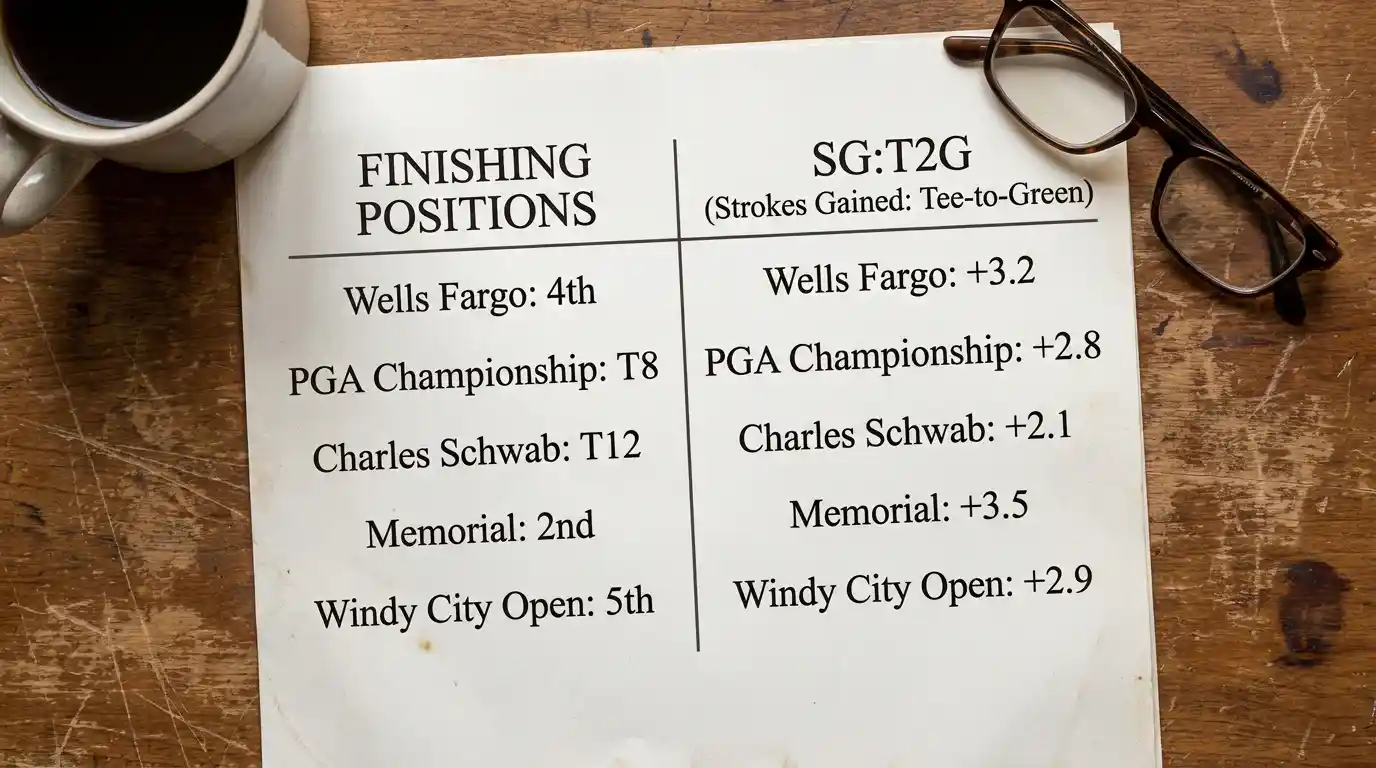
For golf betting, this has a direct implication: a player on “poor form” defined by two missed cuts but with SG:T2G data that was solidly positive in both events is a different analytical proposition than a player on “good form” defined by two top-10 finishes driven by exceptional putting. The market prices the visible results; the SG data prices the actual performance. The gap between the two is where the analytical edge lives.
SG Rolling Averages: The Core Form Tool
A rolling SG average — tracking a player’s SG data across their last 8 to 12 events, updated after each round — is the most reliable form metric available for golf betting. The rolling window smooths out single-week variance while remaining responsive to genuine trend changes. A player whose SG:T2G has been trending upward over the last 6 events is on improving form in the meaningful sense; a player whose SG:T2G has been declining is on deteriorating form regardless of what their finishing positions show.
The 2019 to 2024 Scottish Open data provides a clean example: every winner during that six-year stretch ranked inside the top four on SG:T2G for the week of competition. That is not coincidence — it is the predictive power of current ball-striking form expressing itself in a specific competitive environment. The players who topped SG:T2G at those events were the players whose form, in the SG sense, was peaking at the right moment for a specific course type.
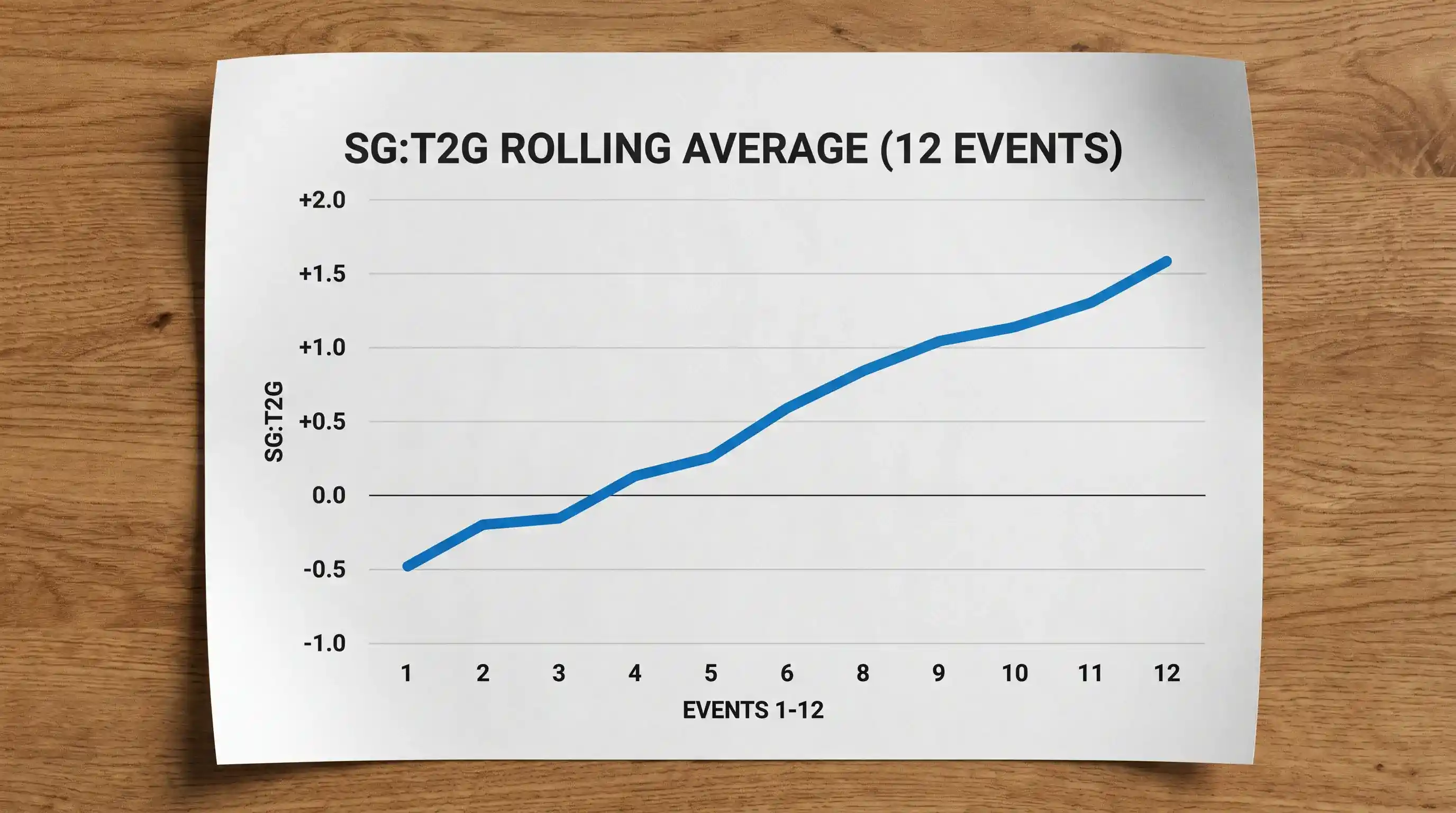
Practically, pulling the SG:T2G rolling average for the entering field from DataGolf or the PGA Tour statistics portal and ranking them against the current bookmaker price is the core of a systematic form-based selection process. The players at the top of the SG:T2G ranking who are priced as 10th-best or 15th-best by the market are the candidates for investigation — not automatic selections, but the pool worth drilling into for course fit, weather, and timing context.
The Fatigue and Schedule Factor
Scheduling is one of the most consistently undervalued form inputs in golf betting. A player competing in their third consecutive week — particularly after trans-Atlantic travel — carries measurable performance risk that SG data alone does not capture. The physical demands of walking 18 holes, the mental concentration required to compete at the highest level, and the disruption to sleep and routine from travel all accumulate in ways that affect performance in the final rounds of a tournament specifically.
The analytical signal to watch is cumulative weeks without a break. A player who has played six consecutive weeks — common during the spring Major swing or FedEx Cup run-in — is in a different physical state to the same player after a two-week rest. The bookmaker’s price rarely adjusts for this factor explicitly, which means it is a persistent source of analytical edge for punters who track player schedules in parallel with their SG data.

There are exceptions: some players maintain performance across dense scheduling because they are physically exceptional or because they thrive on competitive momentum. Identifying individual players who perform above their SG average during heavy schedule periods versus those who degrade is a more refined form of the same analysis — and it produces player-specific scheduling insights that go beyond the general fatigue principle.
Combining Form With Course Profile
Current SG form and course fit are the two analytical pillars of any systematic golf selection process, and they work best in combination. A player in strong current form at a venue that suits their game is a far more compelling selection than either factor alone. The reverse is also important: a player in mediocre current SG form but at a historically-friendly venue is a trap — the market will price their course history positively, and the bet price may not fully discount the form concern.

The most productive analytical workflow is to run SG form screening first — identify the players who rank in the top 25-30% of the field on current SG:T2G — and then apply the course-fit filter to that shortlist. If course history and venue profile favour a player who already passes the form filter, the bet is well-founded on two independent analytical dimensions. If the only case for a player is historical course performance with weak current SG form, the case is thinner than it looks.

For the full SG methodology and how to access and interpret rolling average data for systematic form analysis, the strokes gained golf betting guide covers data sources, category weighting, and how to translate SG metrics into probability estimates for specific events.
How many recent events should I analyse to assess a player"s current form?
A rolling window of 8 to 12 events provides the most reliable form read for most players. Fewer than 6 events introduces too much single-event variance; more than 16 events dilutes the signal from current form with historical data that may not reflect the player"s current technical state. For players who have recently returned from injury or made a significant equipment or coach change, the relevant window may be shorter — focusing on the 5 to 6 events since the change rather than a fixed rolling window gives a more accurate read of their current capability.
Is world ranking a useful indicator for golf betting value?
World ranking is a useful reference for field quality comparison, but it is a poor substitute for SG data in identifying betting value. Rankings aggregate performance across many events and are designed to measure long-term tournament-winning ability, not short-term form. A player who ranked 15th in the world two years ago and has been recovering from injury may rank 35th currently but be in much better current SG form than their ranking suggests. Conversely, a player who performed above their SG baseline for a year and accumulated ranking points may now be regressing toward their true performance level. Always use SG data rather than ranking when the two diverge.
This material was created by SwingEdge team.
