
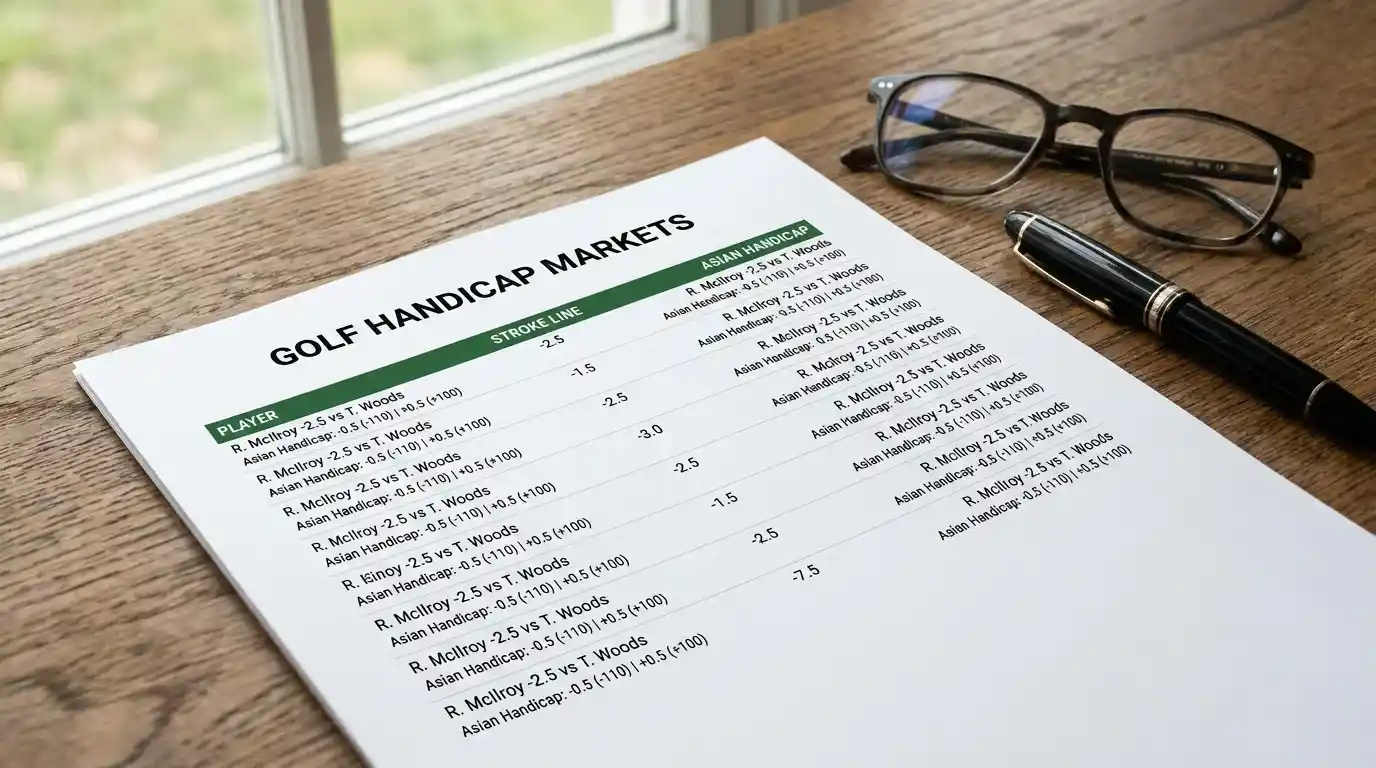
Handicap markets in golf are one of the least-understood products in UK sports betting, and the confusion is understandable — the word “handicap” means something completely different in the golf scoring context versus the betting market context. When a UK punter hears “golf handicap,” they tend to think of a recreational golfer’s scoring allowance. The betting market version is about stroking a line between two players — a betting mechanism that levels the playing field in a head-to-head or field matchup to create roughly 50-50 probability on each side. Done correctly, it can produce genuinely useful edges for punters with SG-based analytical frameworks.
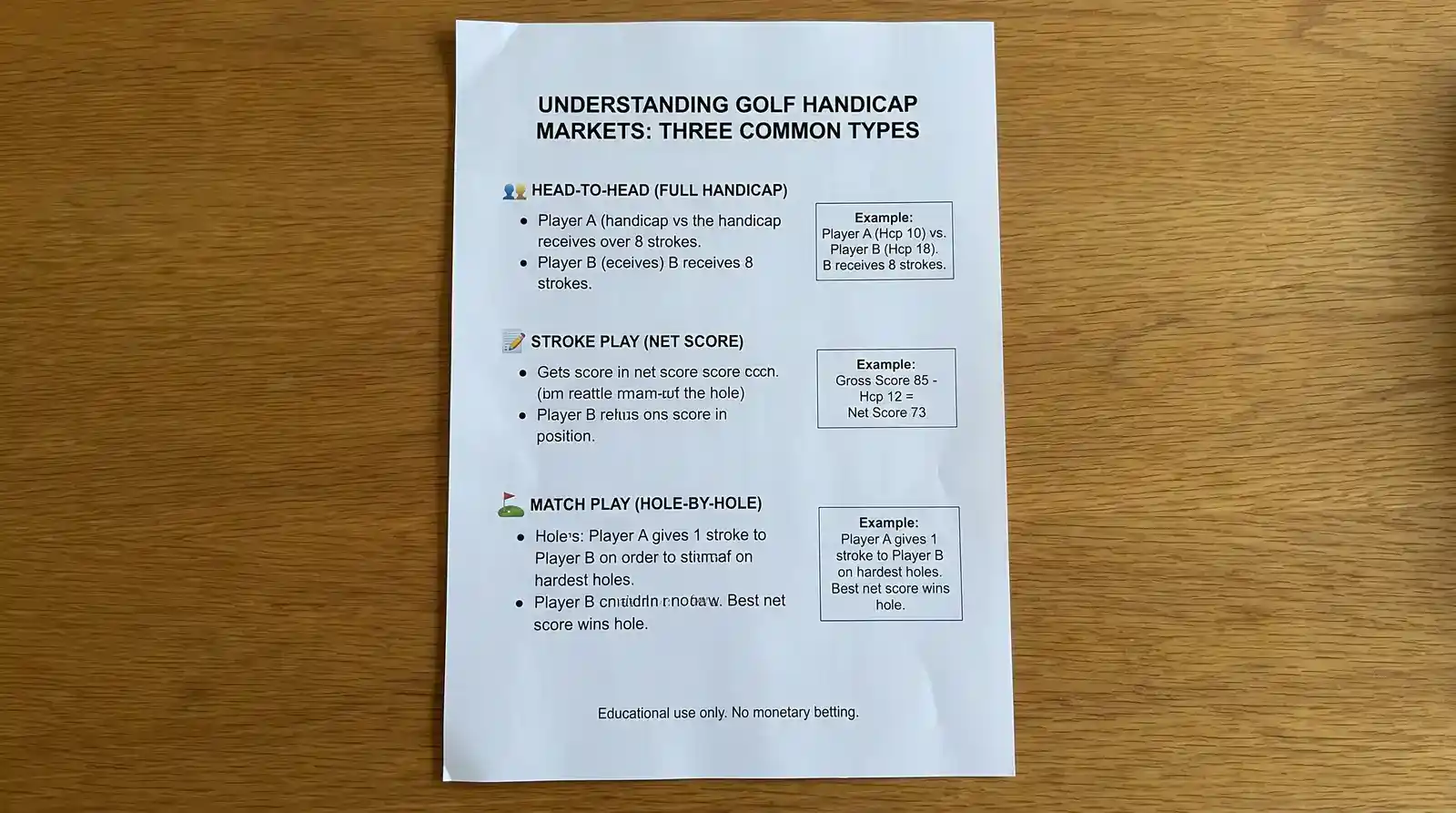
Golf Handicap Market Types Explained
The primary handicap market format in UK golf betting is the stroke handicap line — also called a stroke play handicap or Asian handicap in some operator presentations. In a standard two-player handicap market, a line is set that one player must overcome or stay within for the bet to settle. For example: Player A -2.5 strokes vs Player B +2.5 strokes. You are betting whether Player A will outscore Player B by more than 2.5 strokes across the full tournament, or whether Player B will stay within 2.5 strokes of Player A.
The Asian handicap format removes the possibility of a push: the half-stroke always creates a winning side. Some operators also offer a “European” handicap with whole-stroke lines, where a push is possible if the stroke difference exactly equals the line — and in that case, stakes are returned. Understanding which format you are betting before placing is important, particularly because the odds will reflect different probabilities for the same nominally similar line.
Field handicap markets — where a single player is given a stroke advantage or disadvantage against the overall field — are less common but available at some UK operators. These effectively reprice a player’s implied win probability after the stroke adjustment, which can make a heavily favoured player a more attractive bet on the “win minus 3 strokes” handicap if you believe their margin of victory will exceed the line.
How Stroke Handicap Lines Are Set
Bookmakers set stroke handicap lines by estimating the probability distribution of scoring outcomes between two players and finding the line at which they judge roughly 50% probability on each side, adjusted for their margin. The primary input for this calculation is world ranking and recent form — which is why SG data, which often diverges from world ranking in its assessment of current performance quality, can produce an edge in handicap markets.
If a player ranked 15th in the world is given -2 strokes against a player ranked 40th, the bookmaker is estimating that the rank-15 player is roughly a 2-stroke favourite over 72 holes. If your SG:T2G data shows that the rank-40 player has actually been the stronger ball-striker over recent events — particularly at this course type — the -2 line may be generous to the rank-15 player. The analytical edge in handicap markets comes from having a better current performance estimate than the bookmaker, which is exactly what a current-form SG analysis provides.

For a concrete example of how SG performance translates to scoring outcomes: a player averaging +1.5 SG:T2G per round has a clear statistical advantage over a player averaging 0 SG:T2G over a 72-hole tournament. The expected scoring difference from that SG gap alone is approximately 6 strokes over four rounds, though variance means the actual difference in any single tournament has wide distribution around that expectation. A handicap line of -2.5 on the stronger ball-striker, in this scenario, understates their typical advantage.
When to Use Handicap Markets Instead of Outrights
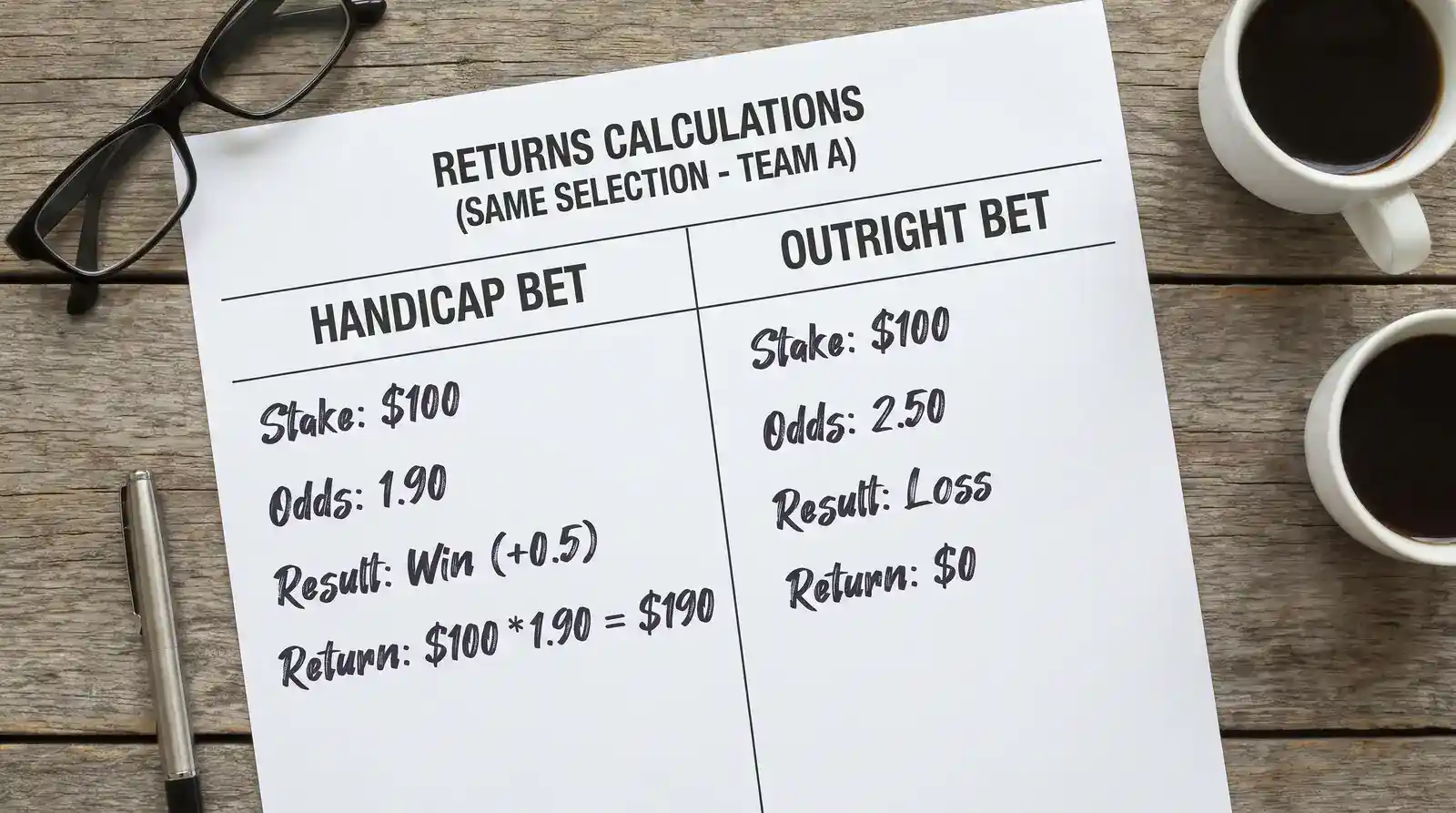
Handicap markets are most useful in three scenarios. First, when you believe strongly in a player’s quality relative to a specific opponent but are less certain about their outright tournament result — the reduced variance of a head-to-head makes the bet cleaner. Second, when a player’s outright market price is short but you believe the handicap line understates their actual margin of superiority — the handicap bet provides better odds for the same directional conviction. Third, when two players are priced very close in the outright market but your analysis strongly differentiates them on current form — the handicap converts your directional conviction into a defined betting line rather than just a slight odds edge in the outright.
The dead-heat rule in handicap markets deserves attention: most UK bookmakers apply dead-heat settlement if the stroke difference exactly equals the handicap line (on whole-stroke lines). For Asian handicap formats with half-stroke lines, there is no dead heat possibility — one side always wins. Confirming settlement rules before placing is straightforward but essential, particularly for larger-stake handicap positions.
Practical Handicap Betting Workflow
Identifying handicap market value follows the same two-stage process as matchup betting: first screen for players where your SG analysis produces a materially different probability distribution than the bookmaker’s handicap line implies; then apply course-fit and scheduling filters to the shortlist before placing.

The most common source of handicap value I identify is players ranked lower on world ranking than on current SG metrics. When a player’s world ranking is 50th but their current SG:T2G ranks them 20th in a specific entering field, they are often given a more generous handicap line by the bookmaker than their current performance warrants — because the bookmaker’s line is built partly on world ranking rather than purely on current form data. Backing the higher-current-form player on the better handicap is the recurring value trade in these markets.
Handicap markets also offer a cleaner edge than outrights during weeks when your selection is strong in relative terms but you are uncertain about outright performance. Handicap betting concentrates the analysis on the relative outcome — does this player outscore their opponent by more than X strokes? — rather than the absolute outcome of winning the tournament. For a punter with a clear directional view on a player matchup but uncertainty about the overall competitive environment, the handicap is the correct market for that conviction.
For more on how matchup-style markets work and how to select between head-to-head, three-ball, and handicap formats depending on the specific analytical case, the golf matchup betting guide covers the full range of player-versus-player market types available in UK golf betting.
How is the stroke handicap line set for a tournament golf market?
Stroke handicap lines are set by bookmakers based on their assessment of the probable scoring difference between two players over the full tournament, adjusted for a margin. The primary inputs are world ranking, recent finishing positions, and head-to-head historical matchup results. SG data is not always fully reflected in bookmaker handicap lines, which means a systematic punter with current SG form analysis may identify lines that understate or overstate the probable scoring difference between two specific players at a particular venue.
Does the dead heat rule apply to golf handicap markets?
Dead-heat rules apply in golf handicap markets where a whole-stroke line is used and the final scoring difference exactly equals that line. For example, if the line is -2 and the player finishes exactly 2 strokes ahead, most operators apply a dead heat — returning half the stake and paying out on the other half at the odds displayed. Asian handicap formats use half-stroke lines (e.g., -2.5) specifically to eliminate the possibility of a dead heat, ensuring one side always wins outright. Always check the specific settlement terms with your operator before placing, as the rules vary between providers.
This material was created by SwingEdge team.
