


I lost my first serious golf betting bank in about fourteen weeks. Not through bad selections — my picks that period were actually reasonable — but through staking that had no structure. When a player I liked won at 40/1, I bet more the next week. When three consecutive each-way bets missed the places, I chased by increasing stakes. By the time I sat down and actually ran the numbers, I’d turned a 50-unit bank into a 12-unit bank without a single catastrophic error. Just a steady erosion from inconsistent stakes.
That experience is depressingly common in golf betting specifically, because of a feature that distinguishes it from most other sports: the variance is extreme. In football, even a significant upset involves one team beating another. In golf, 156 players enter a tournament and 155 of them lose. A punter backing a 33/1 shot each-way every week at the right price is making excellent bets — and can still go six consecutive weeks without a single place return if the variance runs against them. Without a staking framework calibrated for that reality, six bad weeks can wipe out a bank that a disciplined approach would have survived comfortably.
The maths I’m going to walk through here are not complicated. But they require honesty about your actual edge — what it is, how certain you are about it, and how large a losing run it can produce. That honesty, more than any specific staking formula, is what makes bankroll management work in practice.
Why Golf’s Variance Demands Different Thinking
The Open Championship, the Major that most clearly demonstrates golf’s variance, has seen five of the last six winners start at opening odds of 20/1 or longer. Two of those five started at 80/1 or above. These aren’t flukes — they’re the consequence of a sport where 156 elite players compete simultaneously, where conditions interact with skill and luck in ways that are genuinely difficult to predict, and where a single bad round is fatal to any hope of a title.
Put that in staking terms. If you back a player at 33/1 each-way, the theoretical expected frequency of a place return (top five in a full field) for a player of that price — assuming the odds are roughly fair — is around 15-16%. That’s roughly one place return in every six or seven bets on similar selections. In any given run of twenty bets at that price, you can mathematically expect to go stretches of eight, nine, or ten bets without a return. The variance bands around a run of twenty golf bets are enormous.

Compare this to football betting, where you might back match results at 2/1 with a win rate of 30%. In twenty bets, you’d expect six wins with variance bands that produce a minimum of two or three wins in most realistic scenarios. The maximum losing run is shorter, the recovery from drawdown is faster, and the emotional experience of the betting process is less gruelling.
Golf’s structure — specifically each-way betting on longshots across a full season — is a game that rewards patience, statistical thinking, and a bank sized to survive the runs of poor results that are statistically normal even when your selections are well-made. The UK market as a whole reflects the enthusiasm for golf betting — around 9% of UK adults made sports bets in any four-week period as of 2024, with golf among the top three sports — but the punters who sustain profitability are a small fraction of those who enter. The difference isn’t always picking skill. It’s often bank management.
Setting Your Starting Bank
The right starting bank for golf betting is determined by one number above everything else: the minimum number of units you need to survive a realistic losing run without going broke or being forced to restructure your stakes mid-run.
Working from the variance profile I described above: if you’re primarily backing each-way longshots at 20/1 to 50/1, a realistic worst-case losing run over a season is somewhere between fifteen and twenty-five bets without a meaningful return. I’ve experienced runs longer than that in my own betting record — seventeen consecutive bets where the best result was a fifth-place finish that just missed the places under standard five-place terms. Statistically unusual but absolutely within the expected variance band for that type of betting.

To survive a twenty-five bet losing run, your bank needs to contain at least thirty to forty units. Thirty units means you’re left with five to fifteen units at the end of the worst-case run — enough to continue at your normal stake without restructuring. Forty units is more comfortable. The specific pound amount per unit is up to you: if you’re staking £5 per unit, a forty-unit bank is £200. If you’re staking £20 per unit, it’s £800. The key is that the unit size is meaningful to you without being consequential in a way that affects decision-making.
One mistake I see consistently: starting with too small a bank and too large a unit size relative to it. Betting at £25 per unit with a £250 bank — ten units — means a ten-bet losing run ends your operation. Given golf’s variance, a ten-bet losing run isn’t unlucky; it’s routine. The desire to keep the absolute pound amount manageable shouldn’t come at the cost of bank depth. If you can only afford a £100 bank, the unit size for systematic golf betting is £2.50, not £10.
Starting bank size should also account for the minimum number of active bets you’ll typically run simultaneously. If you routinely have four or five each-way selections running across a tournament week, your risk profile is different from someone who places one bet per event. Higher simultaneous bet counts reduce short-run variance (correlated results in the same event can create either compounded wins or compounded losses) but don’t reduce the need for bank depth.
The Flat Stake Plan: Simple, Robust, and Often Underrated
Flat staking — betting the same amount on every selection regardless of confidence or odds — sounds boring. It’s also the plan that most consistently outperforms more complex approaches in practice, particularly for punters whose edge assessment is uncertain or whose sample size is still building.
The mechanics are exactly what they sound like: you establish a unit size at the start of your bank, and every bet costs one unit. A £5 each-way flat stake is £10 per bet (£5 win + £5 place). You record returns in units, and after a defined review period — I typically use fifty bets as a minimum — you assess whether your results justify continuing, adjusting, or stopping entirely.

The advantage of flat staking is that it imposes discipline at the exact moments when discipline is hardest. After a run of losses, the temptation to increase stakes to recover faster is strong. After a run of wins, the temptation to increase stakes because you’re “running hot” is equally strong. Both responses are statistically irrational — past results don’t predict future results at the individual bet level in golf — and flat staking removes the decision entirely. The stake is fixed until you’ve reviewed your record and made a deliberate, evidence-based decision to change it.
For a golf betting operation using each-way bets at average odds of 25/1 to 40/1, a flat stake of 1 unit per bet is appropriate for most punters. If you have a specific reason to think one selection is materially higher value than your standard picks — a clear course-fit advantage combined with an SG profile that stands out — you might stretch to 1.5 units. I’d rarely go above 2 units even on my strongest selections, because the confidence required to justify a 2x stake in a sport with this level of variance is very high, and overconfidence in golf betting has a well-documented cost.
Percentage Staking: When Your Bank Grows, So Does Your Bet
Percentage staking adjusts your unit size as your bank grows or shrinks, so your bets are always a fixed fraction of your current bank rather than a fixed absolute amount. The underlying logic is sound: if your bank has grown through profitable betting, larger absolute stakes are appropriate; if it’s shrunk through a losing run, smaller absolute stakes protect you from ruin.
The typical percentage for golf betting is 1% to 2% of current bank per unit. At 1% on a £500 bank, each unit is £5. If the bank grows to £700, each unit is £7. If it drops to £350, each unit is £3.50. The system self-adjusts without requiring manual decisions at every point.
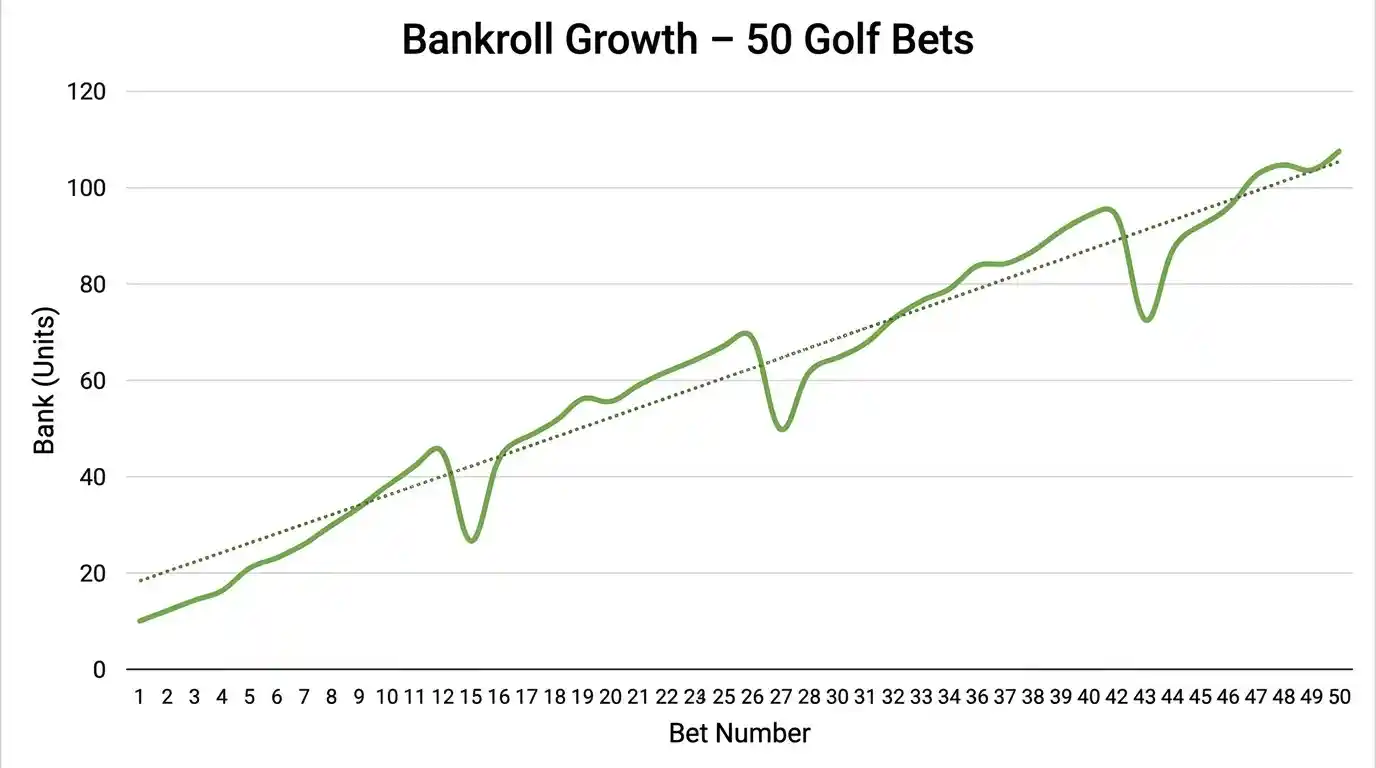
The advantage over flat staking is mathematical: percentage staking asymptotically prevents ruin (you theoretically never reach zero because each subsequent bet is smaller as the bank shrinks) and compounds growth more aggressively during profitable periods. The disadvantage is psychological: when your bank shrinks during a losing run, your absolute stake also shrinks, which means recovering the losses requires not just returning to break-even in percentage terms but actually outperforming. In golf, where losing runs are long and returns are infrequent, this can mean months of operation at very small absolute stakes before a cluster of winners restores the bank to its previous level.
My own view: percentage staking is theoretically superior to flat staking for a punter with a demonstrated edge over a large sample. For a punter still establishing their edge, or for one whose confidence in their selection process is moderate, the practical difficulties of managing percentage stakes across golf’s long variance cycles make flat staking more robust. The difference in outcomes over a full season between 1% percentage staking and 1/50th flat staking (which is equivalent at the starting bank) is usually smaller than the difference between a disciplined staking approach of any kind and an undisciplined one.
Kelly Criterion: Precision Staking for the Disciplined Punter
Both flat and percentage staking sidestep a fundamental question: what is the theoretically optimal stake, given your actual edge? Kelly Criterion is the formula that answers it. Mathematically, Kelly maximises the long-run growth rate of a bank given a known edge — which is why serious professional bettors use it, and why most recreational punters implement it incorrectly and lose more quickly as a result.
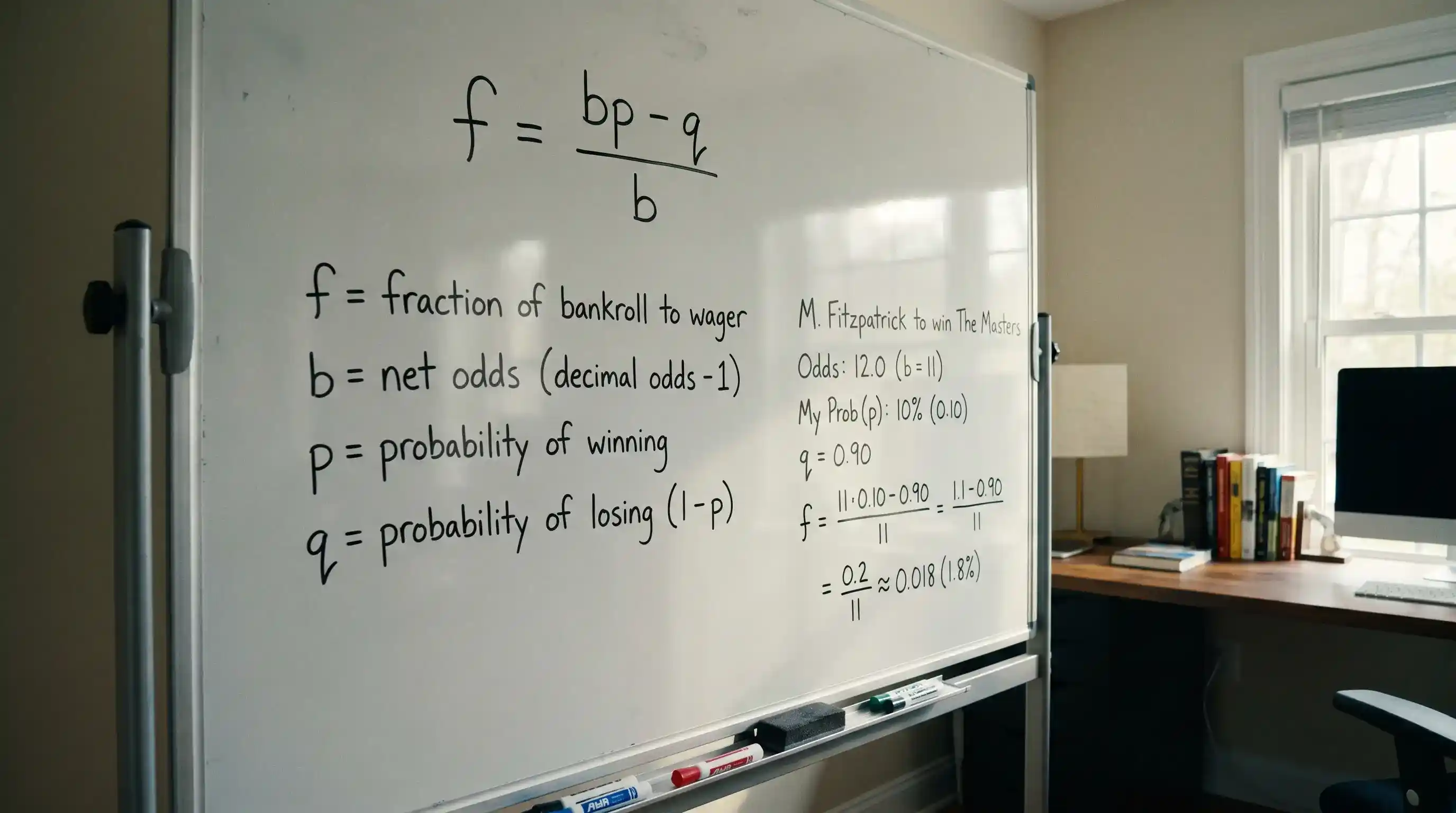
The Kelly formula: stake fraction = (bp – q) / b, where b is the decimal odds minus 1, p is your estimated probability that the bet wins, and q is 1 minus p. If you think a player has a 5% chance of winning and the decimal odds are 26.0 (25/1), the calculation is: b = 25, p = 0.05, q = 0.95. Kelly stake = (25 x 0.05 – 0.95) / 25 = (1.25 – 0.95) / 25 = 0.30 / 25 = 0.012, or 1.2% of bank.
That’s the full Kelly. Most professionals who use Kelly in sports betting use a fraction of it — typically quarter-Kelly or half-Kelly — because the formula is acutely sensitive to probability estimation errors. If you estimate 5% win probability but the true probability is 3.5%, the full Kelly formula tells you to bet twice as much as you should, which accelerates drawdown during losing runs significantly.
For golf each-way betting, Kelly becomes more complex because you have two separate bets — win and place — each with their own probability and odds. The correct application requires estimating the probability of winning separately from the probability of placing, applying the formula to each component, and combining the stakes. This is achievable if you’re using a tool like DataGolf’s Expected Wins alongside a probability model for placing — a player averaging +3 strokes gained per round in a full-field PGA Tour event wins around 55% of the time from a broad field perspective, but your individual selection’s win probability is driven by their current SG form relative to the specific field strength that week.
The practical recommendation: use Kelly as a reference framework rather than a rigid formula. If Kelly says 1.5% of bank and your flat stake is 2%, Kelly is suggesting you’re slightly over-staked; consider trimming to 1.5%. If Kelly says 3% and your flat stake is 2%, Kelly is suggesting the edge is larger than your conservative flat stake reflects; consider whether your probability estimate is sound before increasing. Using Kelly to sanity-check flat stakes rather than to generate them from scratch is a more robust approach for most golf punters, given the probability estimation uncertainty inherent in a sport this complex.
One nuance specific to golf each-way: the “win” probability and “place” probability are correlated but not identical. A player with a 4% win probability might have a 16-18% place probability in a standard five-place market, and a 22-25% place probability in a ten-place market. Running Kelly on the place component separately from the win component — and only if the place bet is independently positive EV — gives a cleaner stake size than trying to combine them into a single calculation.
Record Keeping: The Foundation of Every Staking Plan
No staking plan works without records. That sounds obvious, but the specific information you capture matters as much as the fact of recording. A log that shows only “won” or “lost” is almost useless for improving a golf betting operation. A log that captures odds, each-way terms, SG rank of the selection entering the event, and the course type tells you something actionable.
At minimum, record: date, event, player backed, odds, each-way terms, stake, return, and profit or loss in units. After fifty bets, you can calculate a basic ROI (total profit divided by total stakes) and see whether your operation is positive, negative, or roughly break-even. This is the foundation.

The more valuable layer comes from tagging each bet with the attributes that drive your selection process. Did you back this player primarily on SG form, course fit, historical results, or some combination? Was the event a Major, a Rolex Series event, or a standard tour event? Were the each-way terms standard or enhanced? Over time, these tags reveal which of your analysis dimensions are generating returns and which are not. You may find your SG-driven selections consistently outperform your course-history-driven ones, or that your Major picks have a better ROI than your regular tour picks. That granularity is only available from a well-tagged record.
For a full treatment of record structure, format, and ROI calculation methodology, the dedicated article on golf betting record keeping goes through the practical setup in detail. The brief summary here: start simple, capture everything, and review at meaningful sample sizes — fifty bets minimum before drawing any conclusions about edge or staking adjustments.
When the Numbers Are Telling You to Stop
Bankroll management and responsible gambling are related but distinct concepts. Bankroll management is a tool for punters with a genuine edge to operate sustainably over time. Responsible gambling is about recognising when betting behaviour has become harmful regardless of the edge question.
The statistics from the Gambling Commission’s 2024 survey make this point sharply: 21.9% of adults aged 18-24 in Great Britain had a Problem Gambling Severity Index score above zero — the highest of any age group. The PGSI is a validated measure of gambling harm, and a score above 8 places someone in the “problem gambling” category. Across all UK adults, around 2.5% meet that threshold. These aren’t numbers about people who bet recklessly or without analytical frameworks. They’re about people whose relationship with gambling has become harmful, often in ways that develop gradually.

A staking plan does not protect against this. A punter who is experiencing compulsive gambling symptoms may follow a flat stake plan for weeks and then abandon it during a particularly stressful losing run. The discipline required for bankroll management is a cognitive skill; problem gambling is a behavioural condition that bypasses those cognitive controls.
The practical signals worth knowing: consistently increasing stakes above your plan after losses; continuing to bet after deciding not to; lying to others about the extent of betting activity; experiencing anxiety, irritability, or distress when not betting. If any of these are familiar, the most important next step is not a better staking formula. It’s speaking to someone — the National Gambling Helpline, a GP, or a trusted person who can help you access appropriate support. The analytical framework I’ve been building through this series only has value in the context of a healthy, controlled relationship with betting. Without that foundation, it’s irrelevant.
Frequently Asked Questions
How many betting units should I allocate per golf tournament?
For most systematic golf punters, a total exposure of two to four units per tournament is appropriate when backing multiple each-way selections. This prevents any single tournament from creating a catastrophic drawdown even in a full-bust week where all selections miss. If you"re backing one strong selection per event, one to one-and-a-half units per bet is sensible. Only stretch toward two units when your analysis suggests an unusually clear value opportunity — not as a response to a recent losing run.
What win rate do I need to be profitable with each-way golf bets long-term?
The required win rate depends on the average odds and place terms you"re using. For each-way bets at average win odds of 30/1 with standard five-place terms at one-quarter, you need roughly a 12-14% place return rate to break even at the flat stake. At 25/1 with enhanced ten-place terms, the break-even place return rate drops because you have more finishing positions paying out. The cleanest way to assess this is to run your historical record: what has your actual place return rate been, and does it exceed the break-even for your average terms?
Should I use the same stake for a Major as for a regular tour event?
Not necessarily. Majors produce more variance than standard tour events — the Open Championship winner data demonstrates this clearly — which can argue for slightly smaller stakes to account for wider outcome distributions. However, Majors also tend to offer enhanced each-way terms, which can increase the expected value of each bet. The practical approach: use your standard flat stake for Majors as a baseline, and increase only if the specific terms and your analysis produce a clear case. Don"t routinely stake up for Majors simply because they"re prestigious.
How do I track my golf betting results to measure ROI accurately?
Calculate ROI as total profit (in your unit currency) divided by total stakes placed, expressed as a percentage. For each-way bets, count the total outlay including both win and place components of each bet. Review at fifty-bet intervals minimum. Before fifty bets, the sample is too small to draw meaningful conclusions about edge — variance can produce positive or negative ROI numbers at small samples that revert significantly with more data. Tag bets by analysis type, event type, and each-way terms to identify which dimensions of your process are generating returns.
This material was created by SwingEdge team.
