


I have built profitable golf accas. I have also destroyed weeks of painstaking single-bet work with a poorly constructed golf acca on a Saturday afternoon. The difference between the two is not luck — it is understanding exactly what a golf accumulator is doing to your edge, mathematically, and whether a bookmaker boost is genuinely compensating for the overround you are stacking. The UK golf betting market generates enough outright volume each week that acca products are ubiquitous, but that accessibility obscures a straightforward truth: most golf accas should not be placed.
The Mathematics of a Golf Accumulator
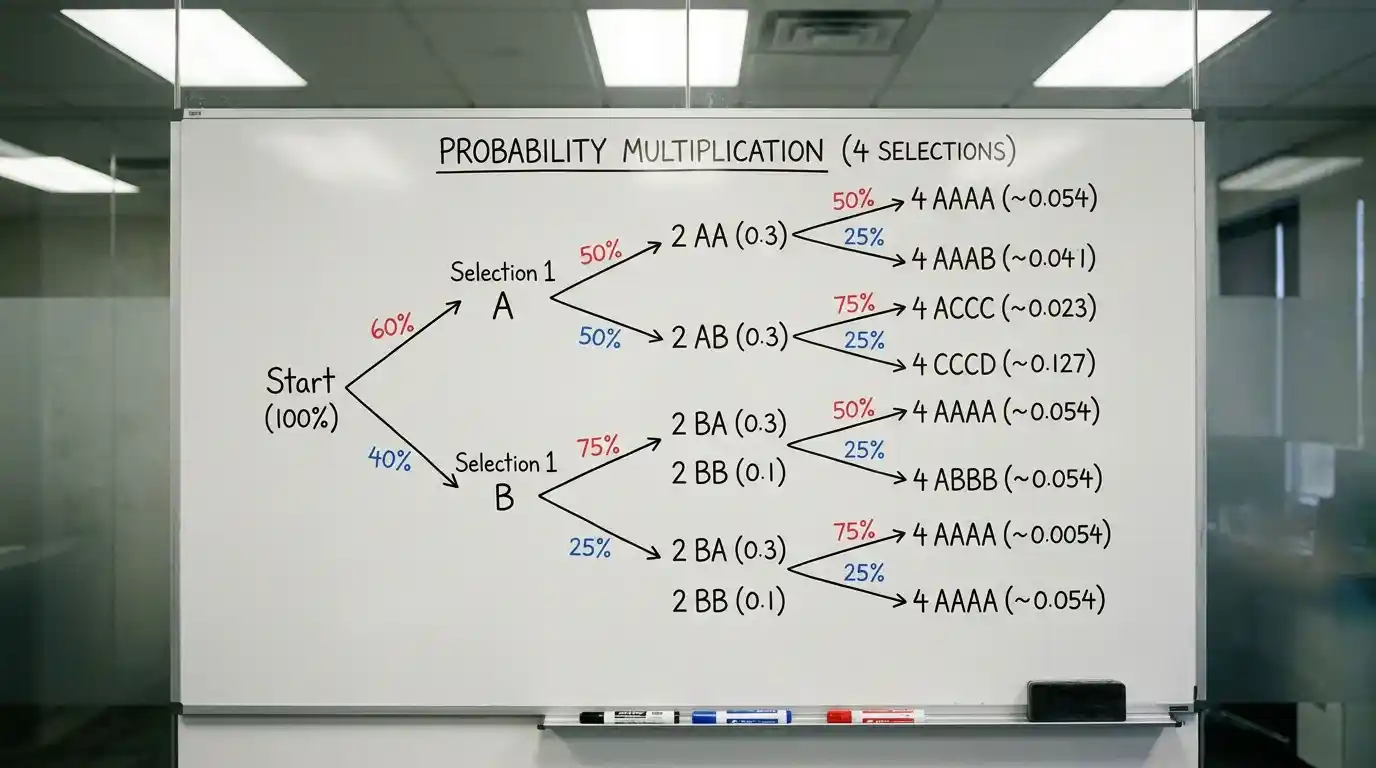
When you build an accumulator, you are multiplying your individual bets together. If each selection in a four-bet golf acca has an implied bookmaker probability of 10% — roughly equivalent to a 9/1 chance — your combined acca probability is 0.10 to the power of four, which is 0.01% or roughly 10,000/1. The bookmaker prices your acca at a return that reflects that combined implied probability, minus their total margin stacked across each leg.
This is where golf accas are uniquely punishing compared to football accas. In football, a 9/1 shot (10% implied probability) might genuinely be estimated at 11% by a sharp bettor — a modest edge. In a full-field PGA Tour outright market, the overround is substantially higher. An outright market with 156 players priced to a book of 130% or more means every selection is approximately 30% more expensive in expected value terms than it should be at fair odds. Multiply four of those across an accumulator and you are stacking negative expected value four times over.
Sports betting in the UK is the largest segment of online gambling, representing over 57% of sector revenue — which means bookmakers have refined their outright golf margins precisely because the volume is there. The margin that feels invisible on a single outright bet becomes structurally destructive when multiplied across an acca.
Acca Boosts: When They Actually Help
The one scenario where a golf accumulator may offer genuine positive expected value is when a bookmaker acca boost compensates for the accumulated overround. BoyleSports, for example, has developed its acca boost alongside its golf market positioning — and the specific terms of those boosts, when applied to selections where the individual bets already have edge, can produce a positive EV combined bet.
The test for any acca boost is simple. Take each selection and estimate your edge on the outright: if you believe a player has a 12% chance of winning and the bookmaker is offering 11% implied probability (roughly 8/1), that is a negative-EV outright regardless of the acca. No boost fixes a negative-EV foundation. But if you have four selections where you estimate genuine positive EV — say, each is priced at implied 10% when you believe 12.5% — and the boost adds another 20% to the combined return, you may be producing a net positive acca.
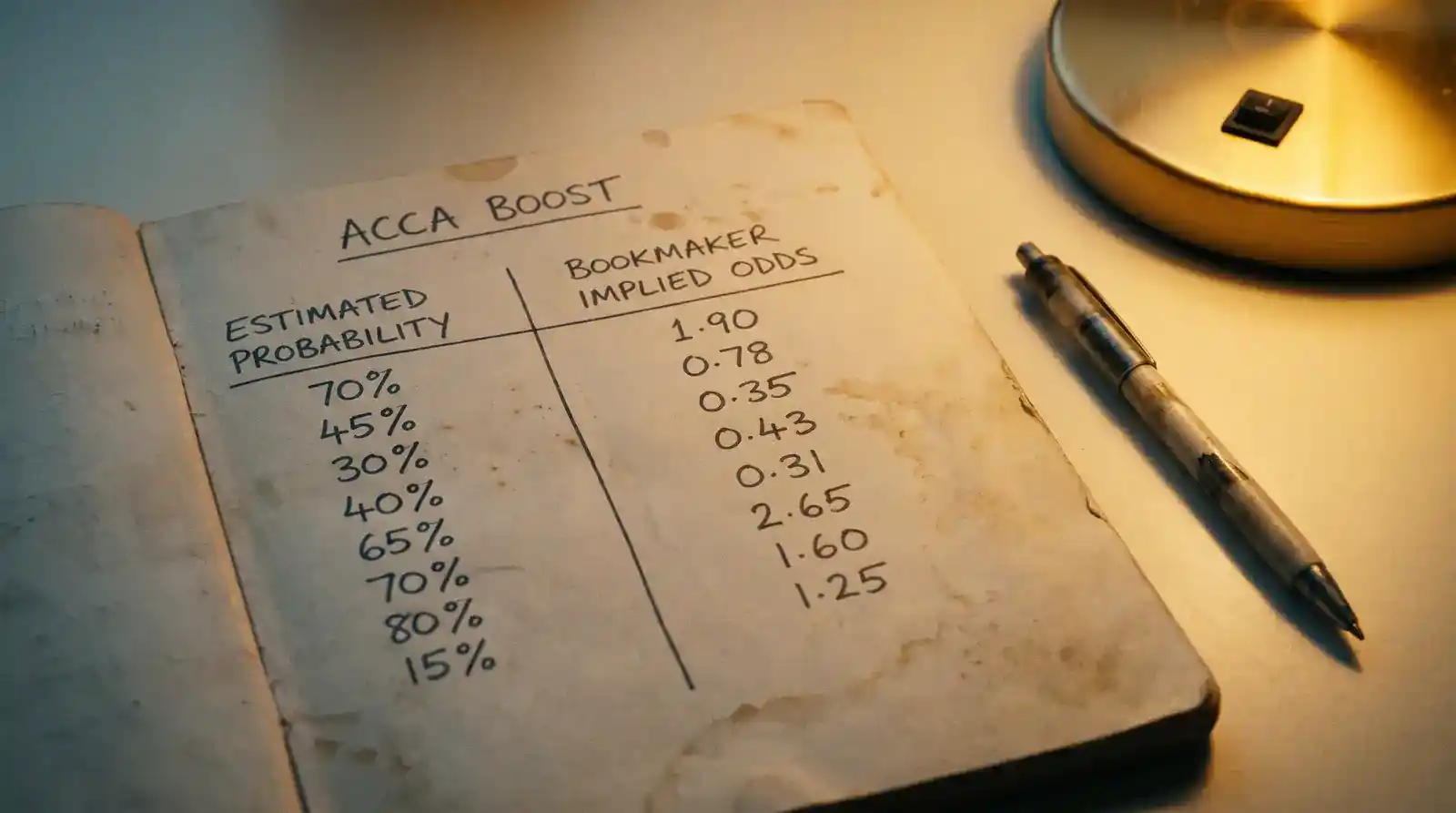
The maths: four selections at 9/1 each multiply to an outright acca return of roughly 9,999/1. A 20% boost takes that to 11,999/1. If your true combined probability is 0.0156% (four 12.5% outcomes multiplied) versus the boosted payout at 11,999/1 (0.0083% implied probability), you have positive EV. But this requires each individual selection to genuinely carry edge — not wishful thinking dressed as analysis.
When to Avoid Golf Accas Entirely
The Open Championship, and Majors generally, are the events where I never build golf accas. The variance data for The Open is instructive: five of the last six winners started at 20/1 or longer. In that environment, you are multiplying low-probability outcomes across an already high-margin market — the mathematical destruction of edge is severe. The same applies to any week where your selections are longshots with 30/1 or longer prices.
Accas also fail when they mix markets of different expected value quality. A three-leg acca where two legs are genuinely researched outright selections and the third is a “banker” at short odds kills your expected return. Short-odds selections in golf — a 7/4 tournament favourite, for instance — carry thin margins and compress your combined return dramatically. The acca payout does not compensate for the certainty you are losing on that leg.

The practical rule I use: build accas only from outright selections where I have individually modelled positive expected value, only when a boost is available that covers the stacked margin, and never during high-variance events where the overround is highest. For platform-specific analysis of which operators offer the most competitive golf acca terms, the best golf betting sites UK guide covers bookmaker-by-bookmaker comparison.
The Psychology Trap in Golf Accas
There is a psychological dimension to golf acca betting that analytical punters are not immune to: the entertainment value of a running multi-bet. When your first two legs land and you are watching the third tournament on Sunday afternoon with a meaningful payout at stake, the experience is genuinely more engaging than any single outright bet. Bookmakers understand this. The acca product is designed partly to produce that engagement, and the margin structure is built around the willingness of punters to trade edge for excitement.

I am not above admitting that I have built accas for entertainment rather than edge. The honest difference between those bets and the analytical ones described above is that entertainment accas should come from a fixed, pre-allocated amount treated as the cost of the experience, not as a serious edge play. Separating “edge bets” from “entertainment bets” is a discipline that protects your overall ROI while allowing the occasional multi-bet experience. If you cannot clearly identify which category a specific acca falls into, it is almost certainly the entertainment category — and should be sized accordingly.

The clearest test: could you defend each individual leg of the acca as a standalone single bet at the same stake? If any leg in the acca would not meet your single-bet criteria — if you would not back it on its own — it has no business being in the acca either. The accumulator does not launder the individual bets; it compounds their expected value, positive or negative. This principle, applied consistently, eliminates most of the golf accas a casual UK punter builds.
Does an acca boost make a golf accumulator positive EV?
Only if each individual leg in the accumulator already carries positive expected value before the boost is applied. A boost compensates for the stacked bookmaker margin across multiple legs, but it cannot convert negative-EV individual bets into a positive-EV combined bet. Calculate your estimated true probability for each selection, compare to the implied probability from the bookmaker odds, and then assess whether the boost is large enough to overcome the combined margin. If each leg is individually negative EV, no boost will fix the accumulator.
How many selections in a golf acca is mathematically optimal?
From a pure expected value standpoint, adding more legs to a golf acca always compounds the negative effect of bookmaker margin — so the mathematically optimal number of legs is zero unless every individual leg carries positive EV and a boost covers the stacked margin. In practice, if you are building a boost-compensated acca, two to three legs is where the boost value most commonly outweighs the compounded overround. Four or more legs rarely produces positive EV even with aggressive boosts, because the accumulated margin of a 130%-book golf outright market becomes prohibitive.
This material was created by SwingEdge team.
