


There is a frustrating experience familiar to every systematic golf punter: your player performs exactly as you predicted — ball-striking in the top 10 of the field, consistent approach play, no blow-up holes — and they finish 14th. Your each-way bet loses. The place portion covered top 5, they finished 14th, and all that analytical work produced nothing. Top-finish markets exist to break that pattern. A top-20 market on the same selection, at the right price, turns that 14th-place finish into a winning bet. The trade-off is lower returns per winner, which means the edge calculation needs to be explicit before you act.
Understanding the Top-Finish Market Types
UK bookmakers offer top-finish markets in several configurations: top 5, top 10, top 20, and occasionally top 30 for larger fields. Each is a simple binary — does the player finish in the specified positions or not? Settlement is based on official tournament results, and dead-heat rules apply when multiple players tie at the boundary position.
The key distinction between top-finish markets and each-way betting is the explicit nature of the risk. An each-way bet bundles a win attempt with a place portion; a top-20 market is a standalone place bet at its own price. That transparency forces you to evaluate the place probability directly rather than absorbing it as part of a combined each-way calculation. For players you believe are likely to finish inside the top 20 but are uncertain about winning, the direct top-finish market is often the cleaner analytical bet.
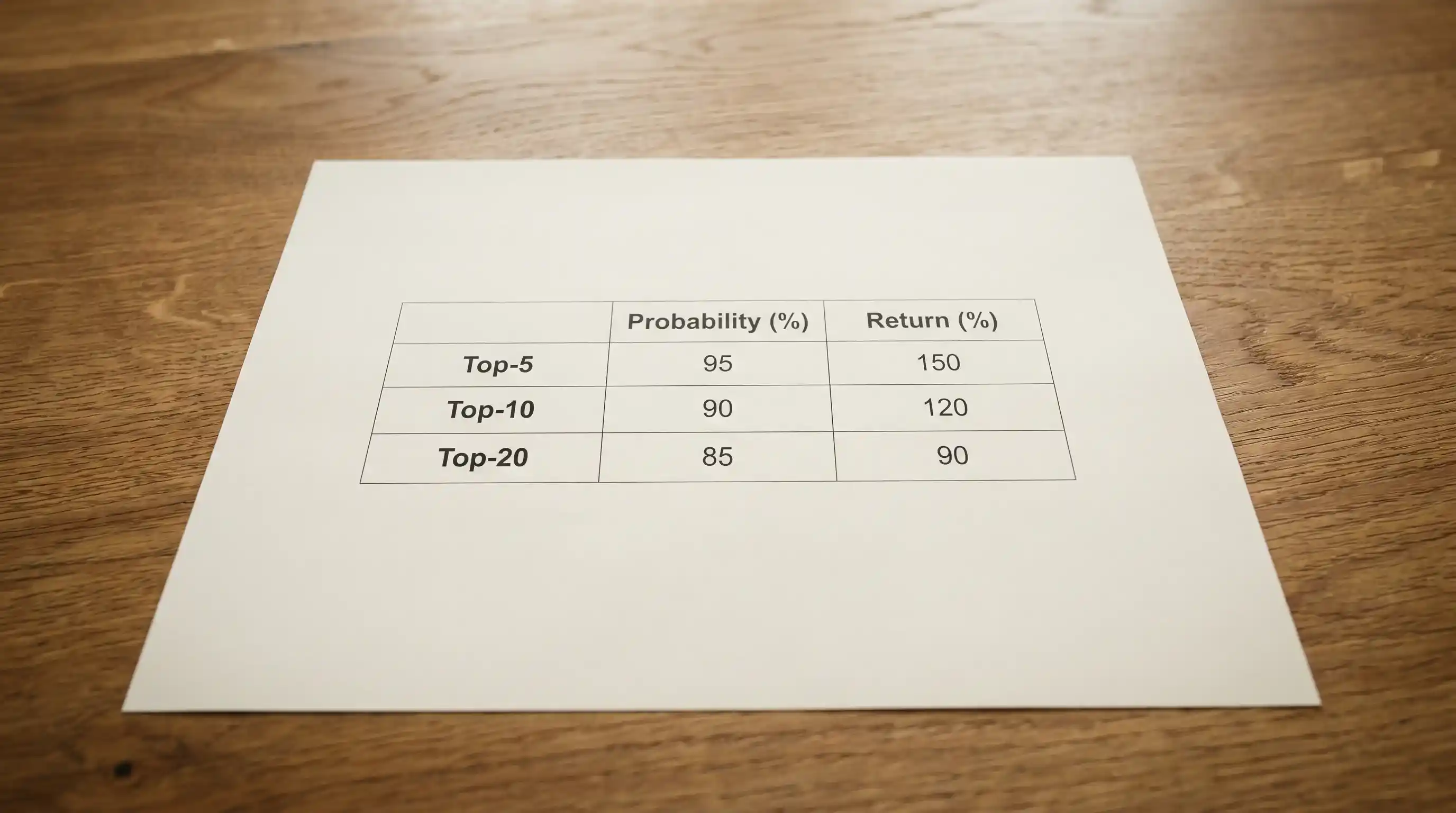
Top-5 markets are the highest risk in this category — you are covering a range that a strong each-way bet would also reach — and their value relative to five-place each-way terms depends heavily on the specific bookmaker pricing. Top-10 and top-20 markets offer increasingly stable outcomes and lower volatility, at the cost of proportionally lower returns per unit staked.
SG Data and Top-Finish Selection
The analytical case for top-finish betting on specific players rests on the same SG foundation as outright selection, but with a different probability threshold. For a top-20 finish in a 156-player field, the player needs to be in roughly the top 13% of the field — a meaningfully different bar than winning outright. A player averaging +1.5 SG:T2G per round in a field averaging 0 has a substantially higher probability of a top-20 finish than of an outright win, and the market often prices these outcomes more accurately than the market prices outright winners.

The Expected Wins methodology from DataGolf is informative here. A player averaging +3 strokes gained per round across all participants at a full-field PGA Tour event wins roughly 55% of the time they hit that performance level — but that same player finishes in the top 20 on the occasions when their performance dips slightly below peak. The top-20 market captures the full distribution of a strong player’s performance, not just the exceptional peak outcomes. That is why consistent ball-strikers who are reliable — but not dominant — candidates are often better value in top-finish markets than in outright markets.

Field Size and Top-Finish Value
Field size changes the top-finish equation significantly. In a 78-player co-sanctioned event, a top-20 finish covers 25% of the field — roughly double the equivalent proportion in a full 156-player PGA Tour event. That changes both the probability of the outcome and what fair pricing looks like.
At a weak-field, smaller event, top-10 markets for strong players can verge on overpriced certainty: a player ranked second in the field on SG metrics might be a genuinely short price to finish top 10 in a 78-player field, and the bookmaker’s price may not reflect that. The reverse is true in full-field Majors, where 156 players with Major-quality credentials compress the top-finish probability for any individual, and the market prices more accurately because there is more sharp money from informed punters.

The practical application: identify your player’s SG standing relative to the specific field, not the world ranking. A player ranked 80th in the world with the strongest SG:T2G data for a specific course type — say, a precision approach player at a tight, short parkland — may have a 25-30% true probability of a top-20 finish while being priced at 15% implied probability (roughly 5/1). That is the top-finish value bet: not the headline name, but the statistical match to the field.
Building a Top-Finish Portfolio Across Multiple Events
Top-finish markets are most effective when approached as a portfolio strategy rather than a single-event selection. The hit rate on top-20 bets for correctly identified SG-dominant players in appropriate fields runs significantly higher than outright bets on the same players. Over a season with 30 or 40 top-finish bets, a 35% hit rate at average odds of 5/2 produces a meaningful profit that an outright betting book at 8% hit rate and 15/1 average odds can struggle to match in consistency, even with comparable expected value per bet.
The portfolio approach also allows you to manage variance more deliberately. In weeks where the field is particularly deep and your SG analysis is uncertain about the top of the field, the top-20 market offers a defensive bet that captures value without requiring you to distinguish between six players who are all credible podium finishers. You back the player you rate highest in the field with the clearest SG edge and let the top-20 outcome absorb the variability in where exactly they finish.
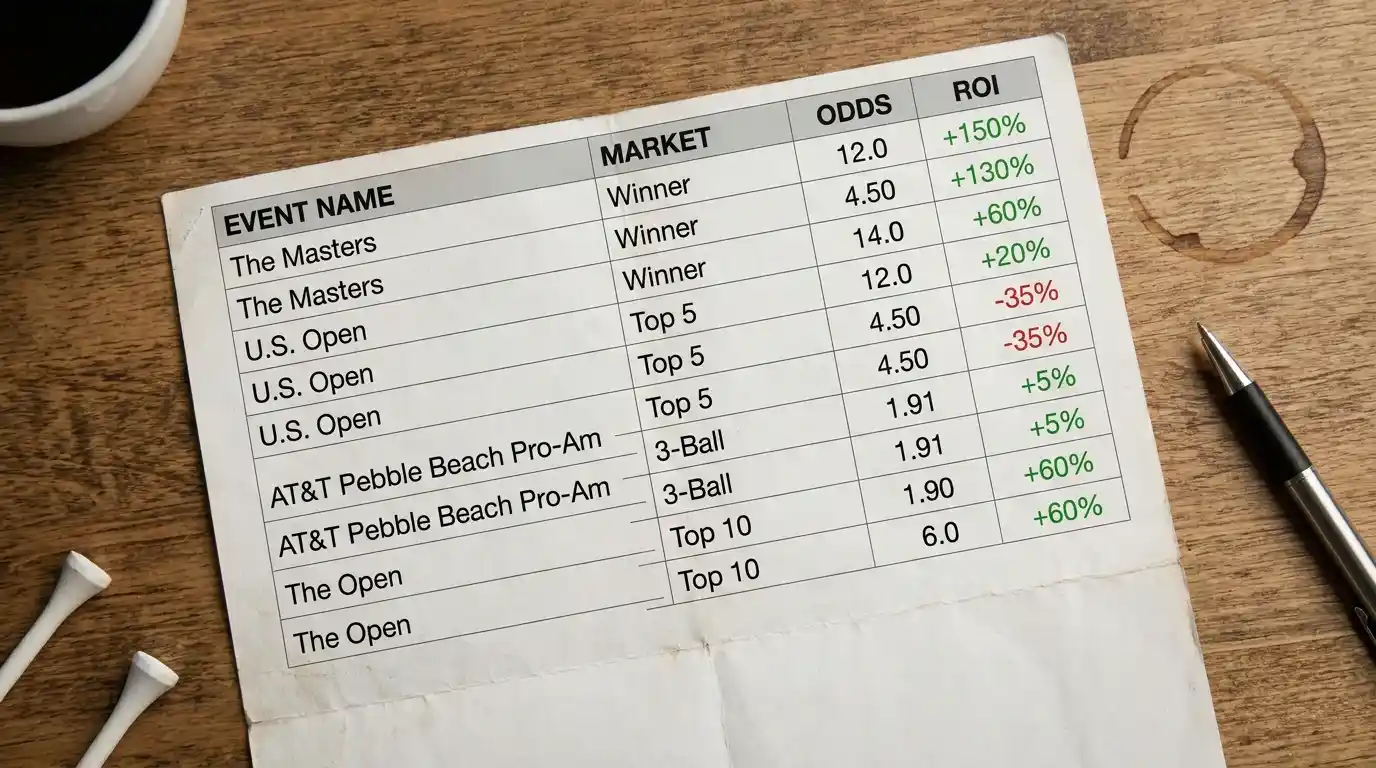
Record-keeping for top-finish markets is more informative than for outright selections precisely because the sample sizes accumulate faster. A systematic punter placing 40 top-finish bets in a season has a meaningful dataset within a single year — enough to calculate a genuine hit rate and ROI by market type (top 5, top 10, top 20) and by player profile (ball-strikers, putting-led players, course specialists). That data reveals which specific types of top-finish selections carry the most edge in your system and which are money-losing habits dressed as strategy.
For a deeper understanding of how each-way returns interact with top-finish market pricing, the framework in the each-way golf betting guide covers the relationship between place terms and alternative finish markets.
Are top-finish bets better value than each-way on weaker-field events?
Often, yes. In a smaller field event with 78 to 100 players, the top-20 market covers a high percentage of the field, and a strong player"s probability of landing inside that range is substantially higher than in a full 156-player event. The each-way market on the same player covers only the top 5 positions, which represents a much narrower slice of the available outcomes. For players with strong SG data relative to a weak field, a standalone top-20 bet may offer cleaner value than an each-way that requires a top-5 finish.
Do top-finish markets include ties or is there a reduction on joint positions?
Dead-heat rules apply when multiple players tie at the boundary position of a top-finish market. For example, if you back a player for a top-10 finish and they tie for 10th with two other players, most UK bookmakers will apply a dead heat — dividing the payout by three. This is standard practice and should be factored into your expected value calculation when assessing top-finish bets at boundary positions. If the player finishes inside the top 10 outright (not tied at the cutoff), full odds apply without reduction.
This material was created by SwingEdge team.
