

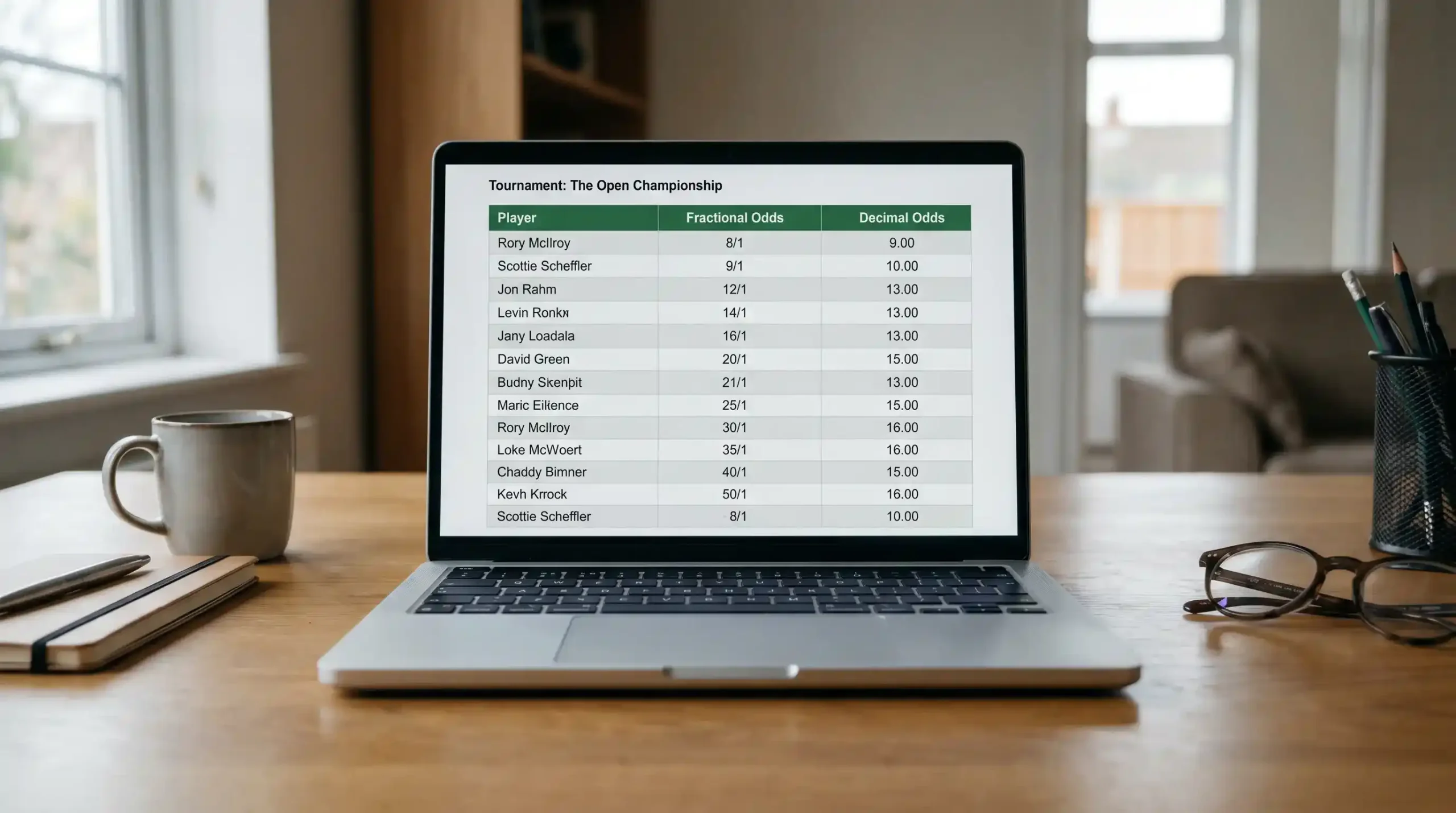
Nine years of systematic golf betting, and I still remember the moment I realised I had been mentally calculating returns in fractional odds while the bookmaker was pricing in decimal — and the small discrepancies in my expected value calculations were coming from that. It sounds minor, but when you are making decisions at the margin of a 2-3% edge, a rounding error in odds conversion is the difference between placing a bet and not placing it. Understanding exactly what odds mean — in every format you encounter — is not basic knowledge for beginners. It is precision tooling for anyone operating a systematic golf betting approach.
The Three Odds Formats You Will Encounter
UK golf betting markets primarily display fractional odds — the traditional British format where 16/1 means you win 16 units for every 1 unit staked. Decimal odds are increasingly common and represent the total return per unit staked including your original stake: 16/1 in fractional is 17.00 in decimal. American odds (moneyline) appear on some US-focused platforms and express the profit on a 100-unit stake for favourites (negative numbers) or 100-unit return for longshots (positive numbers): 16/1 fractional is +1600 in American odds.
The conversion between fractional and decimal is a single operation: decimal odds equal (fractional numerator divided by fractional denominator) plus one. So 16/1 becomes 16/1 + 1 = 17.00. And 5/2 becomes 5/2 + 1 = 2.5 + 1 = 3.50 decimal. Working fluently in both directions takes about a week of daily practice before it becomes automatic. Most UK bookmakers allow you to switch the display format in account settings, which is useful for running calculations in whichever format you think more clearly in.
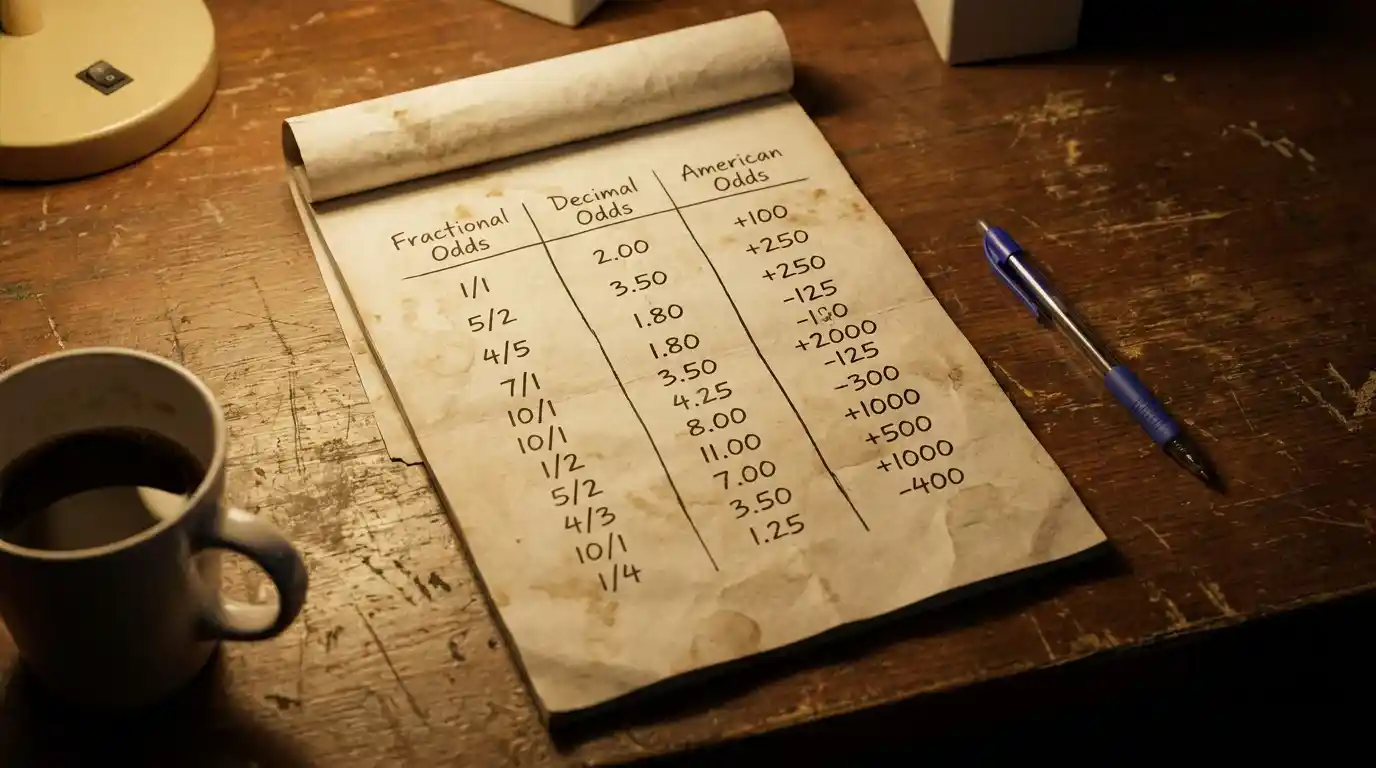
There are around 5,789 betting shops remaining in the UK as of Q1 2025-26 — but the digital migration means most serious golf punters interact with odds on screens rather than chalk boards. The digital format makes decimal odds increasingly natural, particularly for anyone who runs probability calculations where you need to divide 1 by the decimal odds to get the implied probability directly.
Implied Probability and Why It Matters
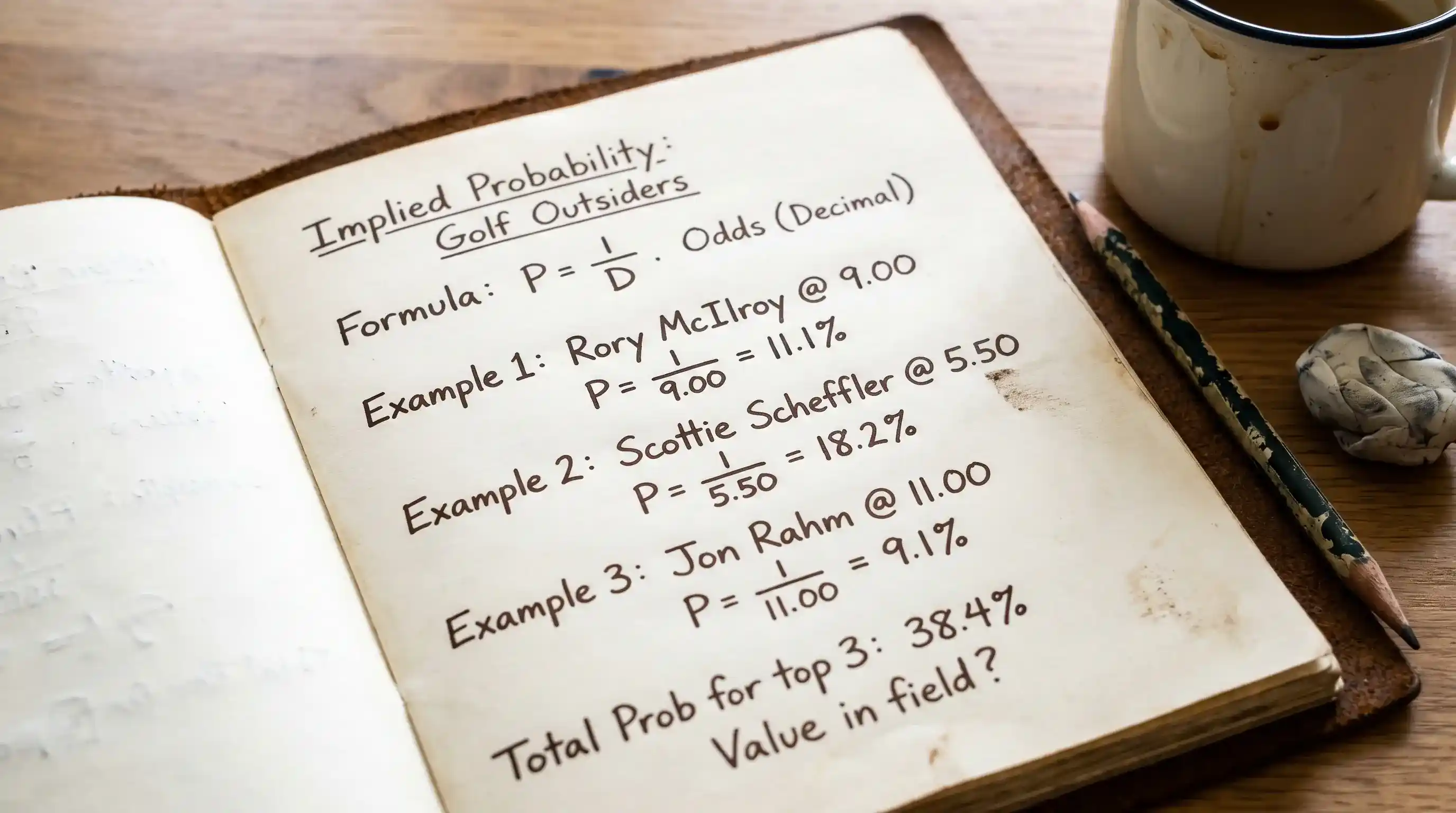
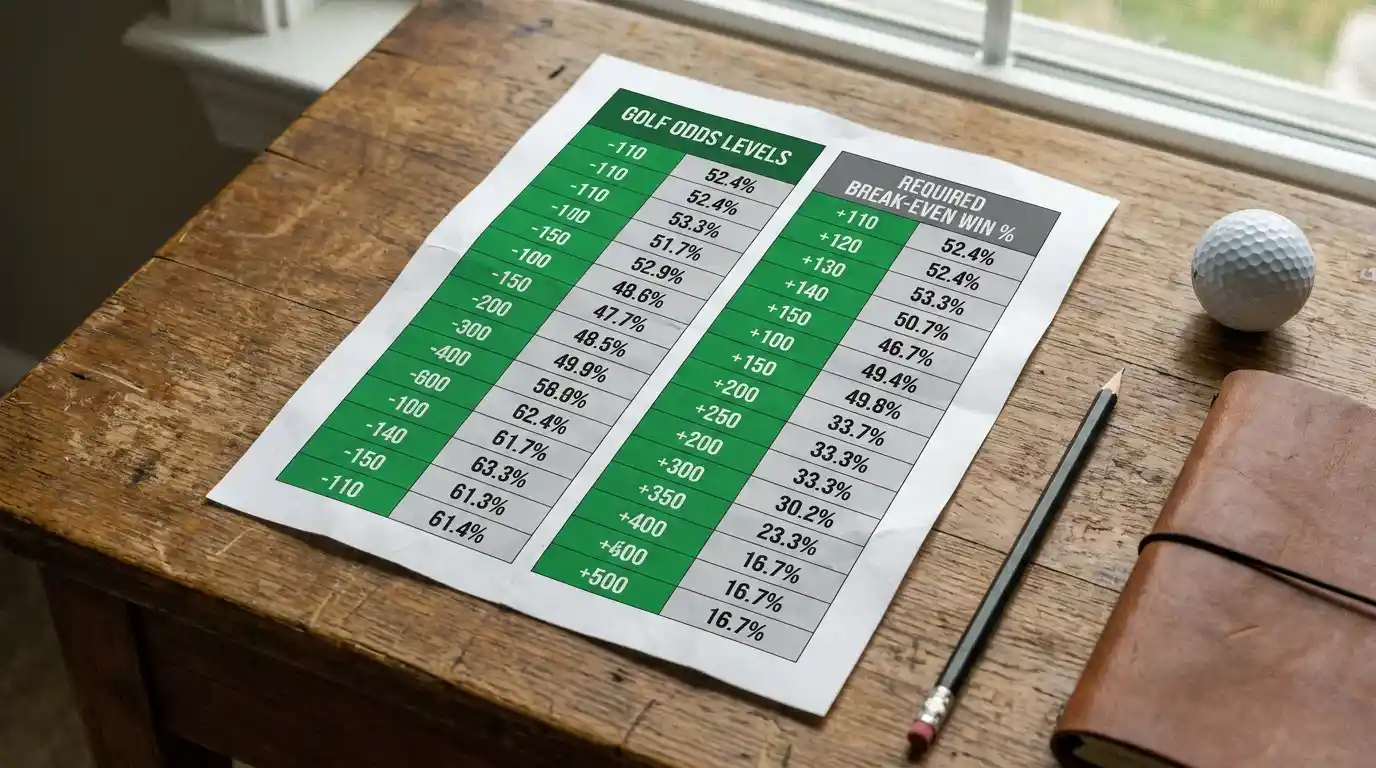
Implied probability is the bookmaker’s stated belief about how likely an outcome is, derived directly from the odds. To calculate it: divide 1 by the decimal odds. A player at 17.00 (16/1) has an implied probability of 1/17.00 = 5.88%. A player at 5.00 (4/1) has an implied probability of 1/5.00 = 20%.
The reason implied probability is the fundamental currency of value betting is that it translates any odds format into a single comparable number. When you have estimated a player’s true win probability at 8% and the bookmaker implies 5.88%, you know the market is pricing them too long — and that a bet has positive expected value. When you estimate 5% and the market implies 5.88%, you know the market is slightly generous and the bet may be negative EV. The probability comparison is more direct than comparing raw odds numbers.
Implied probabilities across a full 156-player golf outright market do not sum to 100% — they sum to 130-140% in a typical UK bookmaker pricing structure. That excess, divided back to each selection, represents the overround: the systematic advantage the bookmaker has on every bet in the market. Understanding that you are always betting into a market with a 25-40% overround in golf outrights is why finding genuine edge requires a probability estimate significantly better than the bookmaker’s implied figure, not just marginally better.
Reading Odds in a Golf Context
Golf odds present in a wide range — from as short as 4/1 for a dominant favourite in a weak field, to 1000/1 for a player the market regards as a rank outsider. The scale of this range is unique among major sports, and it has implications for how you read the market’s signal. A player at 50/1 (2% implied probability) in a 156-player field is being assessed by the market as roughly equivalent to the 50th-best player in the field. A player at 200/1 (0.5% implied probability) is being assessed as well outside the realistic contenders.
The key practical skill is reading where the bookmaker has concentrated their margin within the price range. Very short-priced selections (below 6/1) in golf are typically priced with tighter margins because they attract the most sharp money and the bookmaker has less room to embed overround. Players in the 12/1 to 50/1 range often carry the highest absolute overround in percentage terms. Players above 100/1 are often in the market primarily as service to customers who want to back a long-priced selection — the margin on these prices is variable and sometimes surprisingly wide.
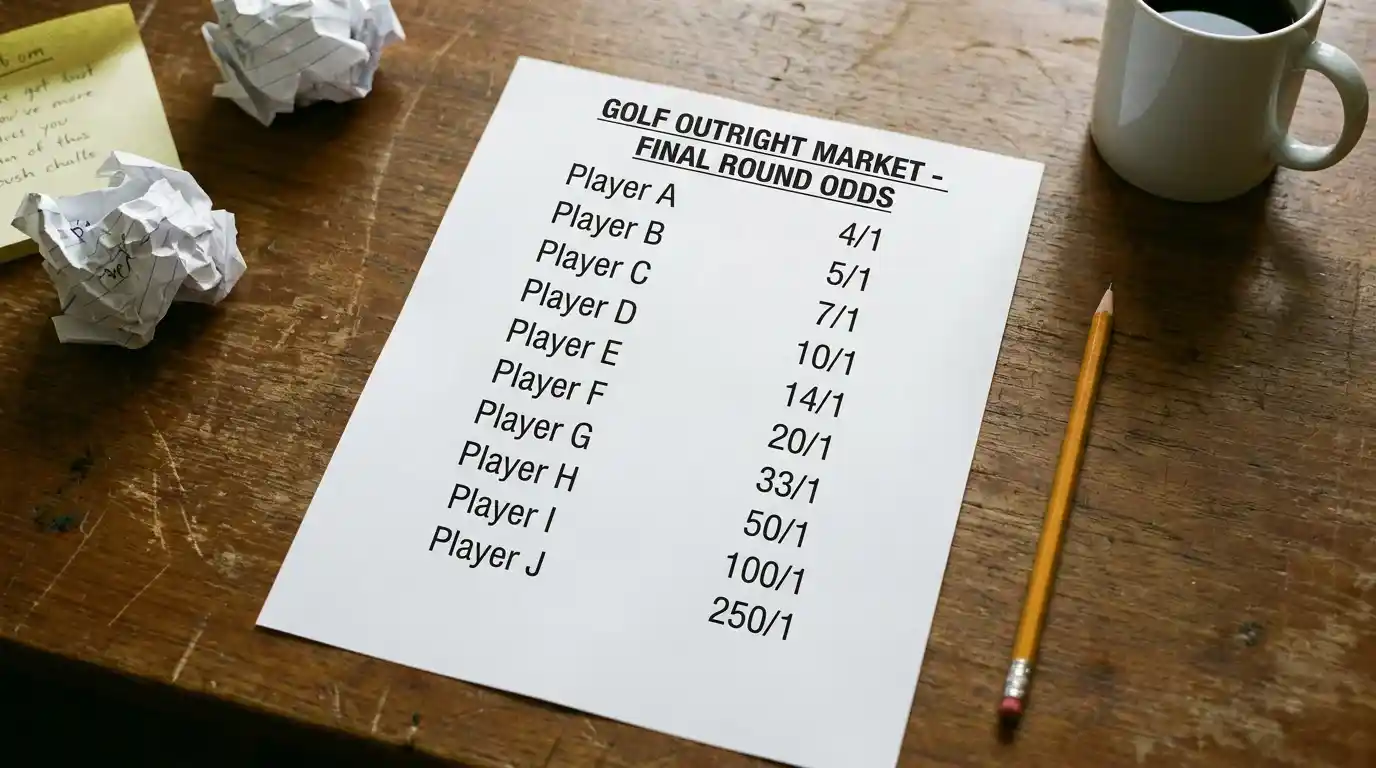
Reading the market’s distribution of implied probabilities across a field also tells you something about the competitive structure: a market with a single 4/1 favourite and a rapid drop-off to 12/1 seconds is very different from a market with six players clustered between 10/1 and 16/1. The clustered market is harder to pick correctly from a win perspective — which is exactly when top-finish and each-way alternatives carry proportionally better expected value for a well-calibrated punter.
Each-Way Odds and the Additional Calculation
Each-way betting adds a layer of odds arithmetic that many UK punters navigate by feel rather than calculation. The place portion of an each-way bet pays at a fraction of the win odds — typically one quarter or one fifth. So if you back a player each-way at 20/1 with quarter-odds, five-place terms, the place portion pays 20 divided by 4 = 5/1 (6.00 decimal). Your each-way bet costs two units: one at 20/1 for the win, one at 5/1 for the place.
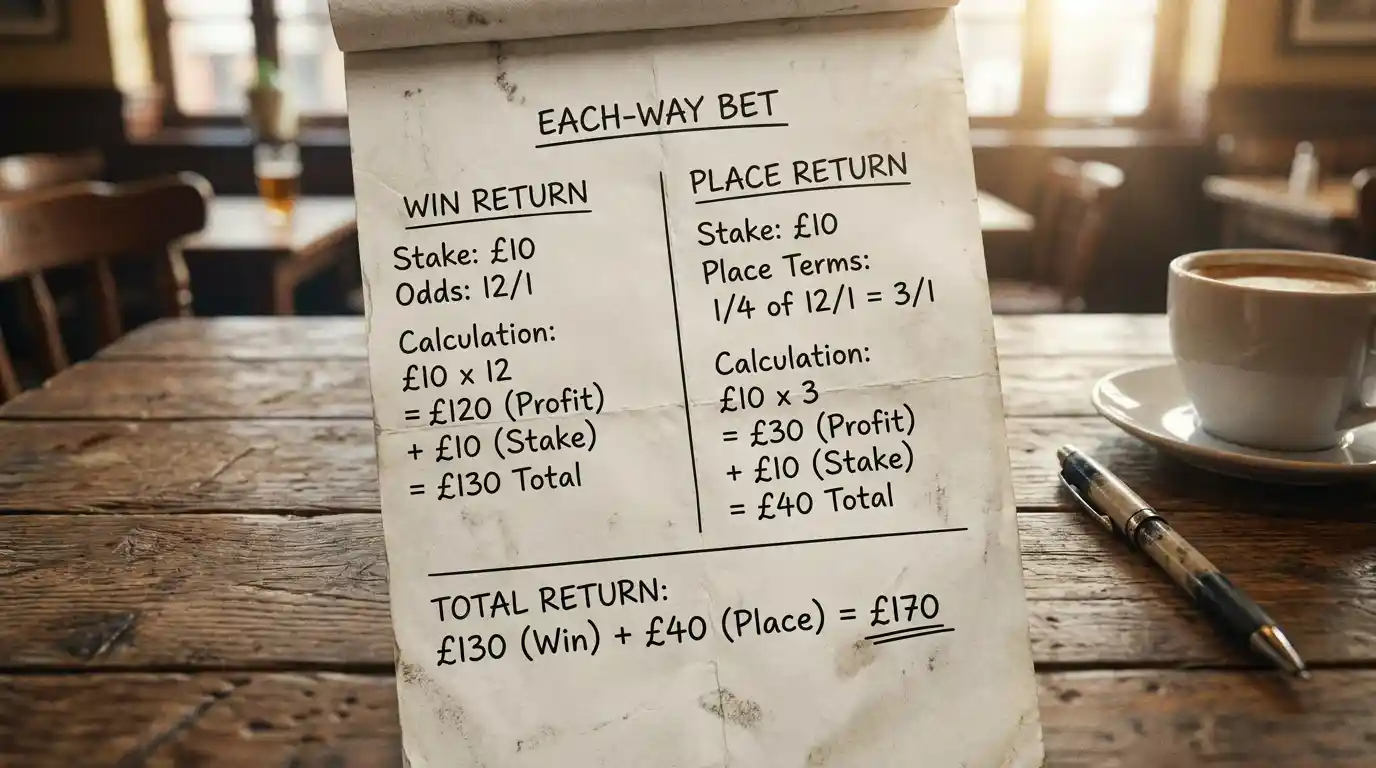
The total return calculation for an each-way bet depends on whether your player wins or places. If they win outright: you collect (20/1 + 1) units on the win portion plus (5/1 + 1) units on the place portion, minus the two units staked = 21 + 6 – 2 = 25 units net profit on two units staked. If they finish second to fifth: you lose the win portion (1 unit) and collect (5/1 + 1 – 1) = 5 units net on the place portion = net +4 units from the two units staked. Being clear on these calculations before placing, rather than after, is the difference between understanding the bet and hoping for the best.
For the full value betting framework that uses implied probability to identify systematic edges in golf markets, the golf value bets guide covers overround calculation, probability estimation, and the practical process of finding positive EV selections week by week.
Why do UK bookmakers display both fractional and decimal odds for golf?
UK bookmakers offer both formats because their customer base has different preferences shaped by experience and age. Older UK bettors are more comfortable with fractional odds, which have been standard in British betting for decades. Younger bettors and those who bet internationally tend to prefer decimal odds, which are easier to use in mathematical calculations and are standard in Europe, Australia, and on exchanges. Most UK sportsbooks allow you to switch between display formats in your account settings without affecting the underlying market pricing.
How do I calculate the break-even win percentage for a golf outright bet at 33/1?
At 33/1 (34.00 decimal), your implied probability is 1 divided by 34.00 = 2.94%. That is your break-even win rate — if you backed every player at 33/1 and they won at exactly 2.94% of the time, you would break even over a large sample. For your bet to be profitable long-term, you need your estimate of the player"s true win probability to exceed 2.94%. If your analysis suggests a 4% true probability, you have a meaningful positive EV edge at 33/1. If your estimate is 2%, the bet is negative EV regardless of how appealing the player seems narratively.
This material was created by SwingEdge team.
