


There’s a moment every serious golf punter remembers — the first time they realised that the standard each-way bet they’d been placing for years was quietly costing them money. Not through bad picks, but through bad terms. I placed three solid each-way bets on a DP World Tour event in 2019 and watched all three players finish inside the top eight. I made a small profit. A punter at the same bookmaker who’d shopped for a better deal that week — one offering eight places instead of five — made twice as much on the same selections. Same analysis, same results, radically different returns.
That’s what this piece is about. Each-way betting in golf is the foundational tool of any UK punter who takes the sport seriously, but the mechanics underneath it are more nuanced than most guides admit. The number of places offered, the fraction of the win odds paid on placed bets, and the range of bookmaker-specific promotions that run throughout the season — these aren’t minor details. They’re the difference between a profitable long-term record and a steady bleed.
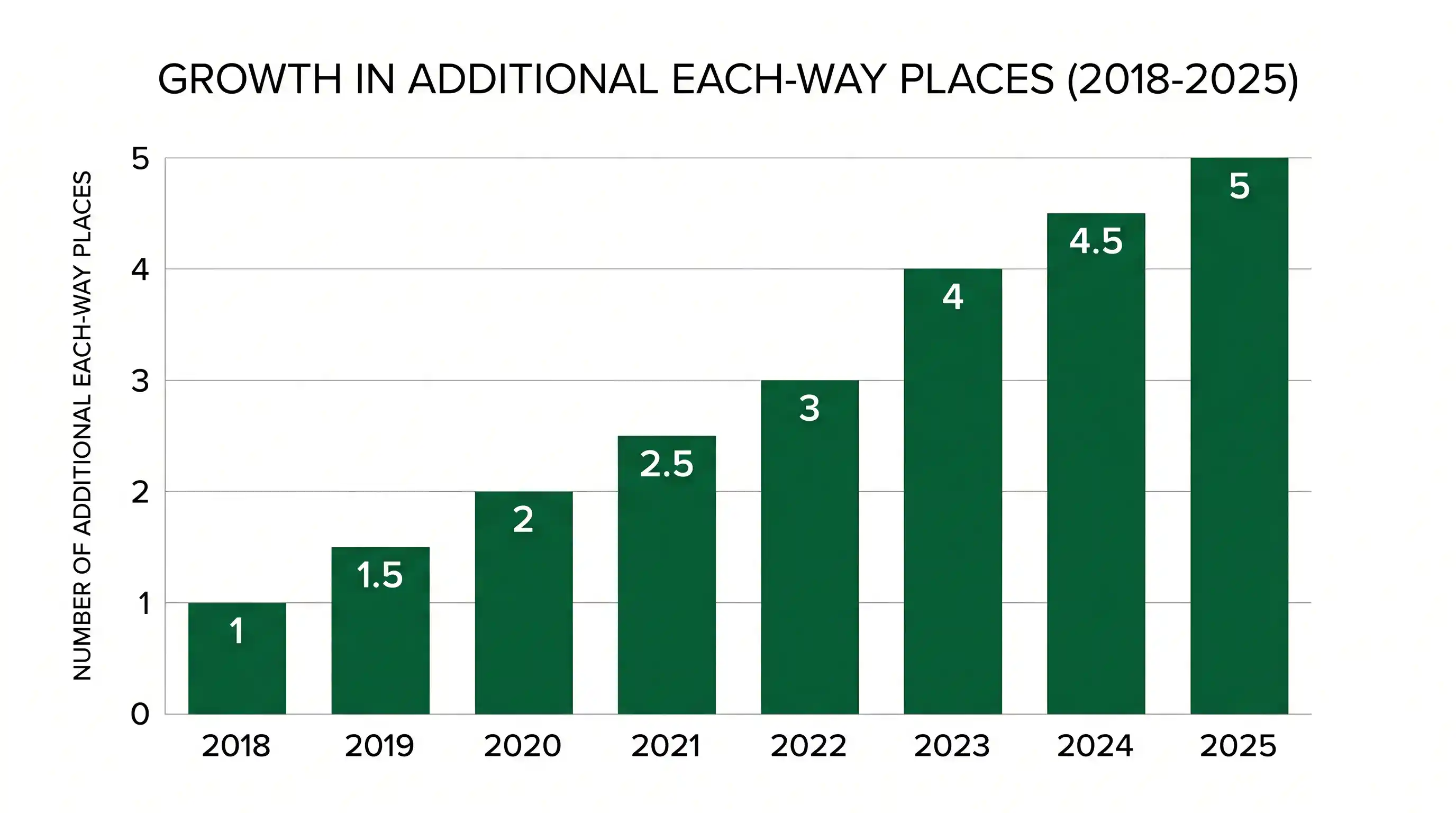
UK bookmakers offered a combined total of more than 1,000 additional each-way places above the industry standard across tracked competitions between 2018 and 2025. Understanding how to access those places — and when they actually matter — is a skill worth building.
How Each-Way Betting Works in Golf
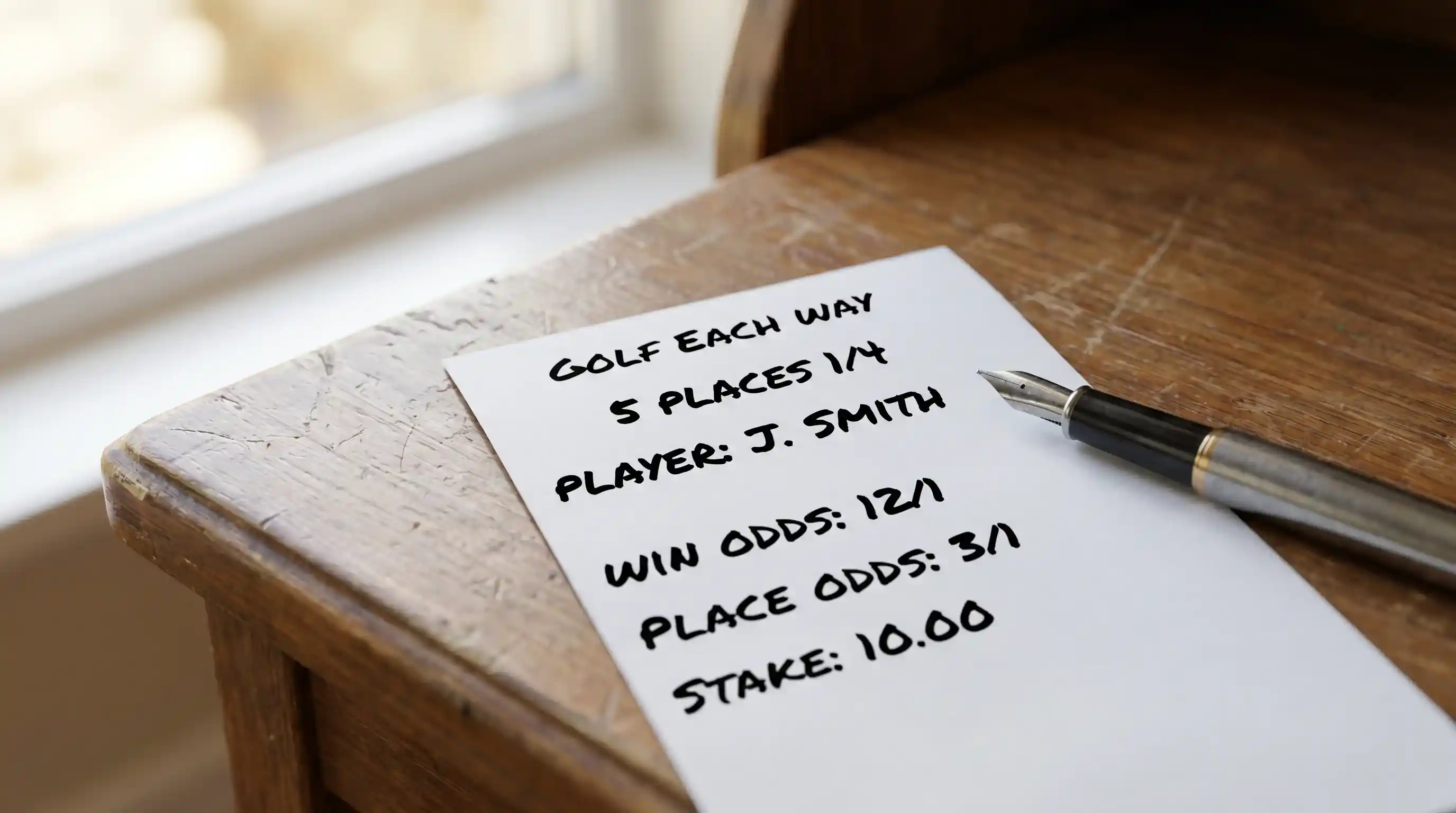
An each-way bet is two bets in one — a win bet at full odds and a place bet at a fraction of those odds. The fraction and the number of qualifying places are set by the bookmaker and vary by event. When you place a £10 each-way stake, you’re committing £20 total: £10 on the outright win and £10 on the player finishing within the specified number of places.
The place odds fraction is where most punters stop reading. In golf, the standard each-way terms are five places at one-quarter (1/4) of the win odds. That means if your selection is priced at 40/1 to win, the place portion of the bet pays at 10/1. If the player finishes second through fifth and you’ve staked £10 each-way, you lose the win part (£10) and collect £110 on the place part (£10 x 10/1 plus your stake back) — a net profit of £100.
Now increase those place terms to one-fifth (1/5) of the win odds at eight places, as several major UK bookmakers offer on bigger events. The place fraction drops slightly — your 40/1 selection now pays 8/1 on the place — but you have three additional positions in which your player can land. On a full-field PGA Tour or DP World Tour event with 156 starters, that difference in place coverage is enormous. The top five finishers represent roughly the 97th percentile. The top eight gets you closer to the 95th. In a sport where even elite players win fewer than 10% of the events they enter, that extra width matters considerably.
The fraction also interacts with odds in a way that isn’t immediately intuitive. At short odds — say, a 10/1 shot in a weak-field event — the 1/4 fraction is less painful because the raw place price is still reasonable. At long odds, where you’re backing 80/1 or 100/1 outsiders, the fraction becomes almost irrelevant relative to the place count. What you want there is pure coverage: as many finishing positions as possible.
One thing worth understanding early: each-way betting in golf is not a risk-reduction tool, it’s a value-extraction tool. You’re not hedging your selection; you’re creating a second, distinct bet on a different outcome. Whether that second bet has positive expected value depends entirely on whether the place odds accurately reflect the probability of your player finishing in those positions — and that’s a question Strokes Gained data can help answer, as I cover in the companion guide on using SG metrics to find betting value.
Calculating Your Each-Way Returns
Run the numbers on enough each-way bets and a pattern emerges: the return profiles are quite different depending on whether your player wins, places, or misses. Getting comfortable with these profiles in advance stops you making emotional decisions mid-tournament.
Let’s work through a concrete example. A player priced at 33/1. Standard terms: five places at 1/4. You bet £5 each-way (£10 total).
Scenario one — the player wins. You collect the win bet: £5 x 33 = £165, plus your £5 stake back = £170. You also collect the place bet: £5 x (33/4) = £5 x 8.25 = £41.25, plus your £5 stake back = £46.25. Total return: £216.25 on a £10 outlay. Profit: £206.25.

Scenario two — the player finishes second through fifth. You lose the win bet (£5). You collect the place bet: £5 x 8.25 = £41.25, plus your £5 stake back = £46.25. Total return: £46.25. Profit: £36.25 on a £10 outlay.
Scenario three — the player finishes sixth or worse. You lose both bets. Total loss: £10.
Now apply enhanced terms — eight places at 1/5. The fractions shift slightly. Place odds are now 33/5 = 6.6/1 instead of 8.25/1. But on scenario two, you now have three additional finishing positions in which you collect. A player who finishes eighth returns: £5 x 6.6 = £33, plus £5 stake back = £38. Profit: £28 on £10 outlay. Under standard five-place terms, that eighth-place finish returns nothing.
The critical insight is this: the value of additional places isn’t just about the fraction, it’s about the probability of your player landing in those extra slots. In a 156-player field, finishing sixth through eighth is a realistic outcome for any player you’d back at 25/1 or longer. Positions six through eight represent roughly a 1.9% slice of the field each. For a player with a genuine top-10 SG profile going into the week, the expected frequency of finishing in positions six to eight might be somewhere in the 8-12% range — and that’s value the standard five-place terms don’t capture at all.
The maths also has an asymmetric quality worth noting. At high odds — 50/1 upwards — the win-only profit dwarfs the place profit so substantially that the fraction becomes a minor concern. The real question at those prices is whether the place terms get you past position five. At shorter prices — say 14/1 on a Rolex Series favourite — the place portion represents a much larger share of total expected return, and the fraction matters more.
Additional Each-Way Places in 2025: What the Data Shows
In 2025, bet365 provided a record 563 additional each-way places above the industry standard through their “Each Way Extra” feature — across Majors, PGA Tour, and DP World Tour events throughout the calendar year. That’s not a marginal improvement. It’s a systematic extension of coverage that changes the risk-reward profile of dozens of bets across the season.
To put that number in context: across all tracked events between 2018 and 2025, UK bookmakers collectively provided more than 1,035 additional places above the standard terms. The trajectory has been broadly upward, driven primarily by two mechanisms: standard-market place extensions (where a bookmaker simply offers more places as a baseline for certain events) and dynamic enhancement products (where additional places are available on request, sometimes at adjusted fractions).
BoyleSports moved into serious contention in 2025, reaching the top position for additional places in standard markets across full-field PGA Tour events. Their offering included ten places at 1/5 as a baseline on selected events, plus a “Pick Your Place” feature allowing punters to select between six, ten, or twelve places on the same runner at differing price fractions. That flexibility is genuinely useful for a punter who’s identified a player with a strong placement profile but uncertain win potential — you can tune your exposure toward the outcome you think is most likely.
The picture across other major UK bookmakers in 2025 was consistent on Majors, with Betfred, Coral, and Ladbrokes all offering ten places at 1/5 for The Open Championship. That’s a meaningful departure from the standard five places at 1/4 that applies to most regular tour events, and it affects the maths considerably on any long-priced selection you’re backing in Majors specifically.
There’s a practical workflow that comes out of this. Before committing to any each-way golf bet, I check the current terms at the two or three bookmakers where I have active accounts. This takes under five minutes and has saved me from the most preventable source of value leakage: placing with inferior terms when a better deal exists elsewhere. The time of week matters too — enhanced terms for weekend start events often appear on Wednesday or Thursday, so checking early in the week versus late can yield different numbers.
What the 2025 data reinforces is that the each-way market is competitive in a way it simply wasn’t a decade ago. Bookmakers are using enhanced place terms as a customer acquisition and retention tool, which means the smart punter who tracks these changes systematically has an ongoing structural advantage over one who doesn’t. The tracker at GolfBettingSystem.co.uk has documented these changes since 2018; it’s one of the most practically useful data sources I’ve come across for golf betting specifically.
How Bookmakers Actually Compare on Each-Way Terms
Comparing bookmakers on each-way terms isn’t as simple as finding the one with the most places. The fraction matters, the event scope matters, and the difference between an ongoing standard offer and a one-off promotion matters a great deal for anyone building a repeatable process.
The industry standard for golf each-way is five places at 1/4. Any bookmaker meeting this baseline is doing the minimum. What separates the genuinely useful operators for golf punters is what they offer above that baseline, and how consistently they offer it.
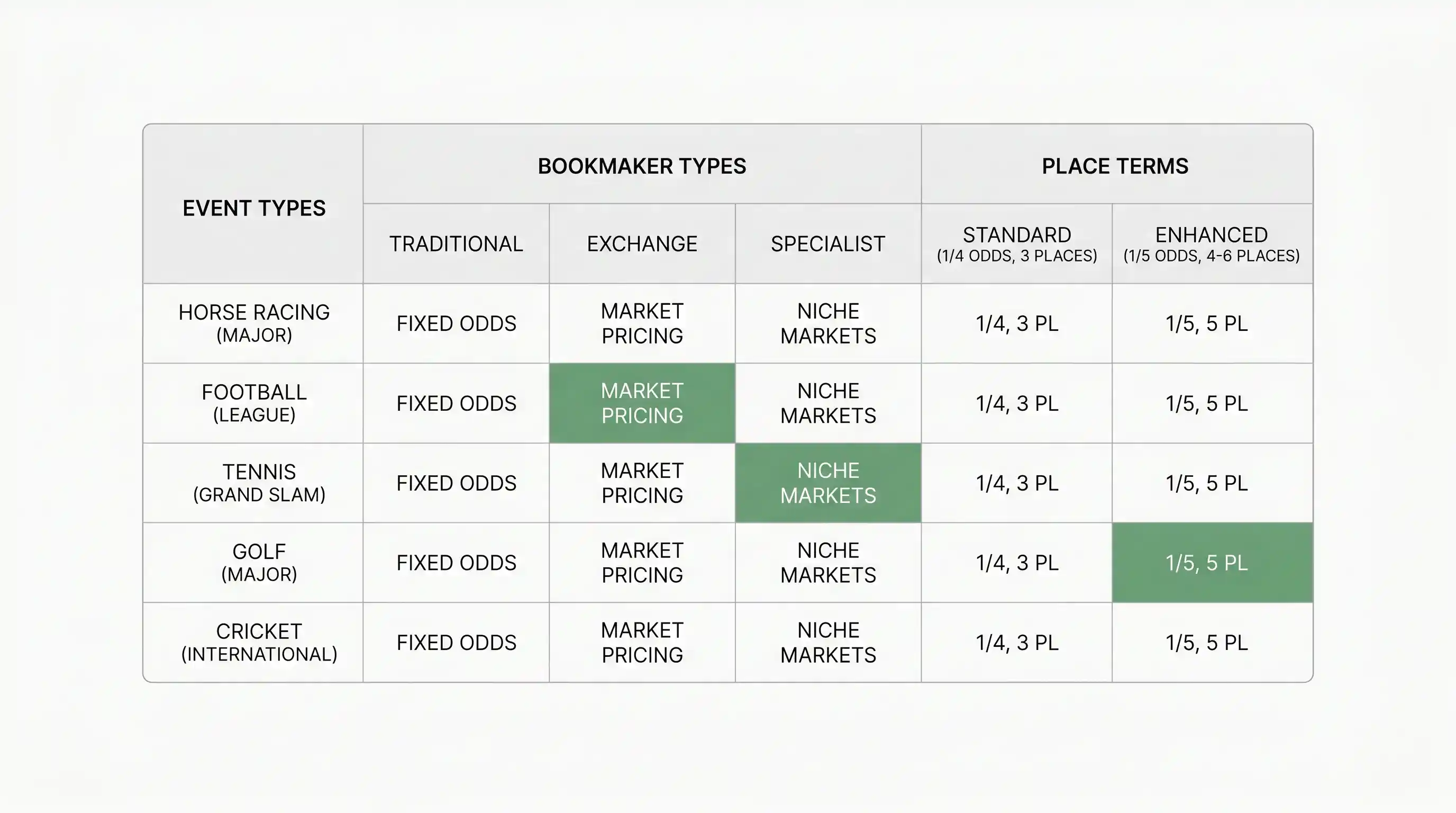
Bet365’s Each Way Extra product is distinct from a standard place extension because it’s dynamic — the number of additional places and the price fraction can vary event-to-event, and you opt in at the point of placing the bet. The advantage is flexibility; the disadvantage is that you need to check the specific terms for every event rather than relying on a consistent baseline. The 563 additional places they delivered in 2025 demonstrates the scale of the offering, but the per-event terms can range considerably.
BoyleSports’ approach in 2025 was arguably more punter-friendly from a planning perspective. A consistent offer of ten places at 1/5 across full-field PGA Tour events means you can factor those terms into your pre-bet analysis without uncertainty. The Pick Your Place product adds a layer of customisation — if you want twelve places at a tighter fraction, you can access that — but the standard offer is reliable enough to build a weekly workflow around.
Coral and Ladbrokes, which operate under the same parent company, tend to align on enhanced terms for the biggest events. Their ten places at 1/5 for The Open Championship in 2025 was a standard industry response to the Major calendar, and both are worth keeping as accounts for that reason. Betfred has historically been aggressive on place terms for Majors specifically — their approach to event-level enhancements is worth monitoring around the four Majors each season.
The practical recommendation: maintain accounts with at least three bookmakers with different each-way approaches. One that leads on dynamic enhancements (bet365-style products), one that leads on standard place extensions (BoyleSports-style offers), and one that competes for Majors specifically. Comparing terms across these three before every significant tournament takes minutes and ensures you’re never knowingly placing at inferior terms when a better deal exists elsewhere.
One thing I deliberately avoid in this comparison is treating any bookmaker as universally superior. Terms shift seasonally and the competitive landscape changes as operators respond to each other. The tracker approach — monitoring which bookmaker is currently leading on which type of event — is more robust than any ranking I could publish today and which might be outdated by next month.
Field Size and Why It Changes Everything
Field size is the variable most casual each-way bettors ignore, and it’s the one that most directly determines whether enhanced place terms are worth pursuing or not.
Here’s the basic logic. In a 156-player full-field PGA Tour event, five places represents 3.2% of the field. Ten places represents 6.4%. For a player with a genuine top-10 probability — let’s say 15% based on their SG profile — those additional five finishing positions might translate to an extra 4-6% probability of the place bet paying out. At typical each-way odds for a 20/1 shot (5/1 on the place part at 1/4), that’s real expected value.
Now apply the same logic to a 78-player invitational event or a co-sanctioned event with a thin field. Five places represents 6.4% of the field. The probability gap between five and ten places is substantially smaller simply because the pool is shallower. Equally, the odds on your selection are likely to be compressed in weaker fields — a player who’d be 33/1 in a 156-player field might be 12/1 in a 70-player field. The place fraction matters more at shorter odds, as I described earlier, but the range of outcomes is also narrower.
The practical upshot: for full-field events, I prioritise access to the bookmaker offering the most places above the standard. For smaller invitational or limited-field events, my energy goes into identifying whether the win price is fair rather than optimising the place terms. The math on enhanced places in a weak field rarely justifies the extra account-management overhead.
There’s also a specific scenario worth flagging: events with multiple cuts or a moving cut line. Some DP World Tour events use a 65-and-ties cut format rather than the PGA Tour’s standard 65-and-ties, which can occasionally produce dramatically different effective field sizes in the final two rounds. A tournament that starts with 156 players but has 90 make the cut creates a different each-way profile than one where 65 make it. The place terms that looked attractive at the start of the week look less impressive when the effective final-round field is only 65 players deep.
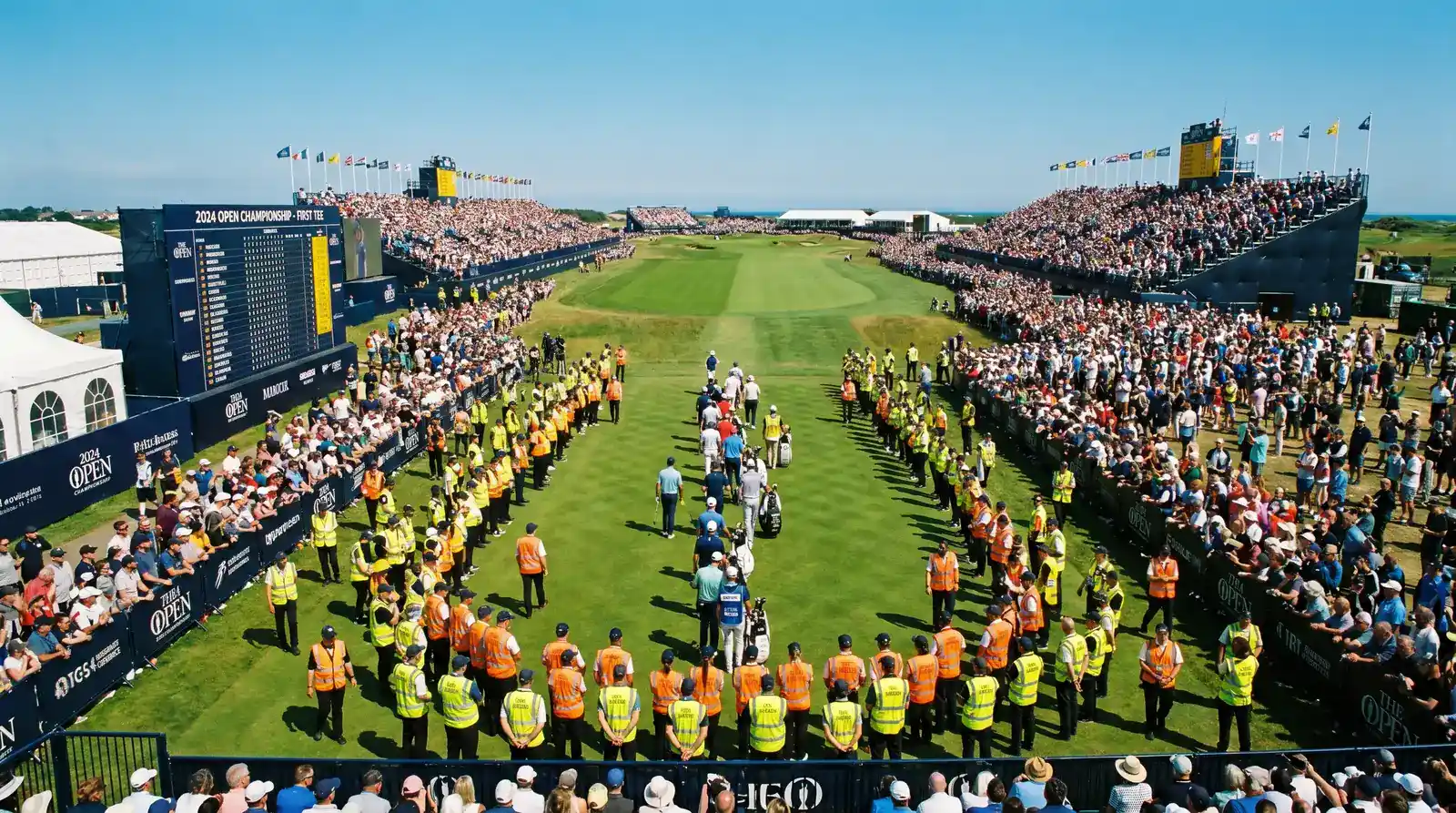
The Open Championship sits in a category of its own on this dimension. It runs a 156-player field through two rounds with a 70-and-ties cut — typically leaving around 70-80 players for the weekend. The place terms for The Open are set based on the full starting field, not the final round field, which is part of why its enhanced terms carry genuine structural value for longshot backers.
Majors vs Regular Tour Events: Different Rules, Different Maths
The each-way structure of Majors deserves its own treatment because the standard assumptions don’t apply. Five of the last six Open Championship winners had opening odds of 20/1 or longer, including two who started at 80/1 or above. That variance profile — unpredictable winners, meaningful place range, large field — is exactly what enhanced each-way terms are designed for.
The standard offer during non-Major events on the PGA Tour and DP World Tour is typically five places at 1/4. That’s the number to beat. For Majors in 2025, the benchmark shifted: ten places at 1/5 from multiple operators for events like The Open Championship. The change in fraction from 1/4 to 1/5 reduces your place return per placed position, but the additional five positions more than compensate for any player you’re backing at 25/1 or longer.

Run the numbers on a 40/1 selection with standard terms versus Major terms. Standard: five places at 1/4 = place odds of 10/1. Major terms: ten places at 1/5 = place odds of 8/1. The place return per £1 stake drops from £10 to £8. But your probability of collecting on the place bet has potentially doubled, depending on where your player is likely to finish. A player with a genuine top-10 profile in a Major should be collecting that place return more often under ten-place terms than five-place terms, and the frequency gain outweighs the fraction loss in most scenarios above 20/1.
The Masters and the US Open present slightly different dynamics. Augusta National produces a lower-variance scoring distribution than links Majors — the course architecture constrains the range of viable winners more than, say, Carnoustie or Royal Troon in adverse conditions. The each-way terms are still enhanced during Masters week, but the rational basis for backing long-priced outsiders is weaker than it is for The Open specifically.
PGA Tour signature events and Rolex Series events on the DP World Tour occupy a middle ground. Full fields, elevated prize funds, stronger fields — but not quite Major volatility. The place terms offered by some bookmakers for these events in 2025 approached Major-level extensions, which occasionally made the each-way maths attractive for players at 25/1 to 40/1. These are the events where checking terms on Wednesday — before the market sharpens post-draw — often yields the best combination of price and enhanced place terms.
Frequently Asked Questions
What is "Each Way Extra" and how does bet365 calculate additional places?
Each Way Extra is a bet365 product that offers additional place terms above the standard each-way offer on selected golf events. The number of extra places and the fraction applied can vary by event. Rather than a flat upgrade applied to all markets, it works dynamically — you see the enhanced terms at the point of placing the bet and opt in specifically for that selection. Bet365 provided 563 additional each-way places above industry standard through this feature across golf events in 2025.
Does a higher number of each-way places always mean better value in golf betting?
Not automatically. More places is better only when the fraction loss is outweighed by the probability gain. At short odds (say 10/1 or below), moving from 1/4 to 1/5 fractions hurts the place return meaningfully and more places may not compensate. At long odds (25/1 and above), additional place coverage almost always improves expected value because the frequency gain matters more than the fractional difference. The maths depend on the specific odds and your estimated probability that the player finishes in those additional positions.
How do Coral and BoyleSports options compare for Major tournaments?
Both offered ten places at 1/5 for The Open Championship in 2025, which was the standard enhanced offer across most major UK bookmakers for the event. BoyleSports differentiated itself through the Pick Your Place feature on regular tour events, allowing punters to choose between six, ten, or twelve places at varying fractions. For Majors specifically, the place terms across the main UK operators were broadly similar; the difference comes in regular season events, where BoyleSports" standard ten-place offering on full-field PGA Tour events was an outlier compared to most competitors.
When is it better to take a straight win bet rather than each-way in golf?
A straight win bet outperforms each-way when the odds on your selection are short enough that the place portion barely adds expected return, or when the bookmaker"s overround on the place market is high enough to make the place bet negative EV. Practically, if you"re backing a player at 10/1 or shorter in a regular tour event with standard five-place terms, the each-way structure dilutes your stake across a lower-return place bet rather than concentrating it on the win. At short prices in weak fields, a win bet is often the cleaner approach.
This material was created by SwingEdge team.
